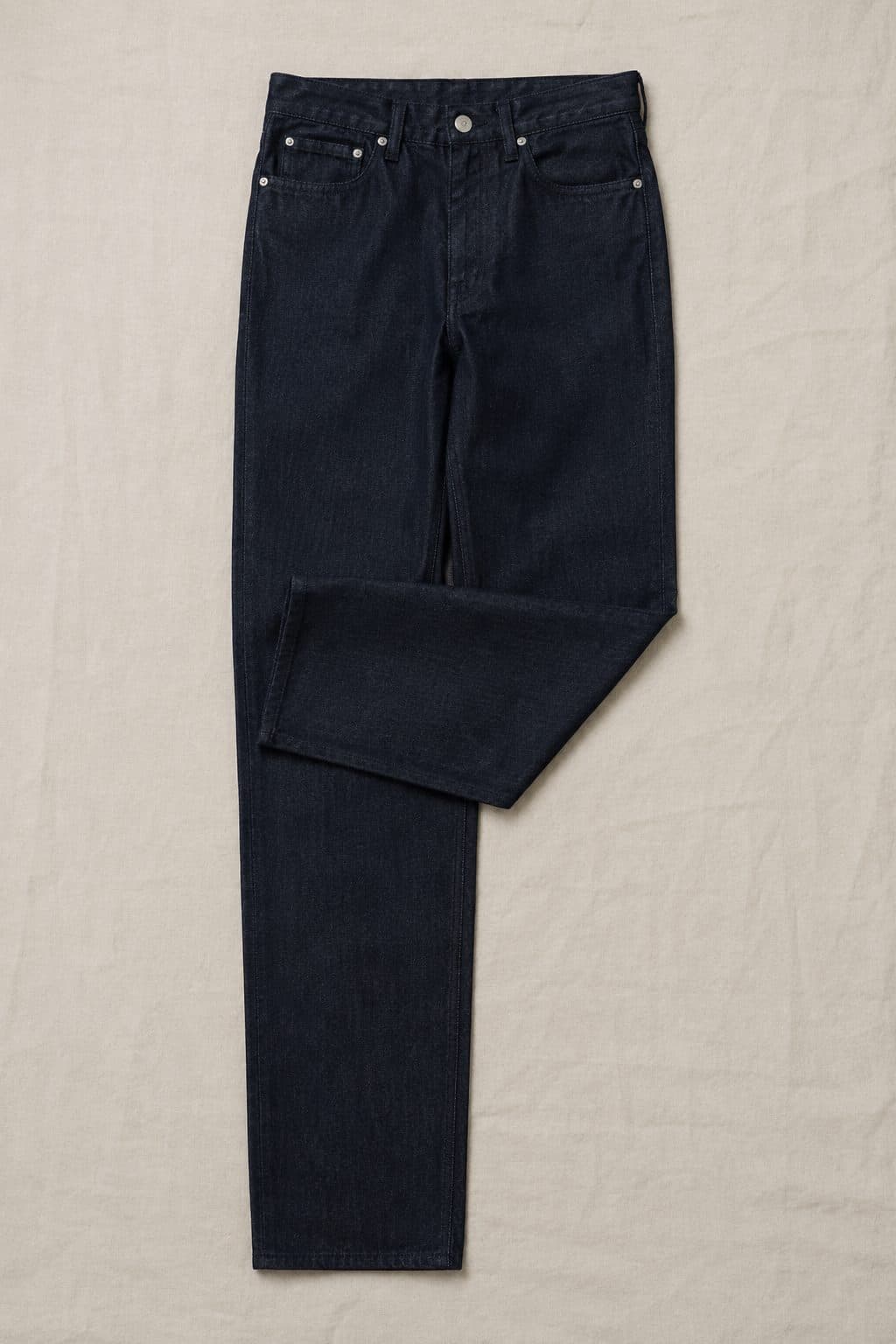
Day 0
Stiff, dark, and a size long
Unwashed cloth arrives hard enough to stand up on its own. It is cut long on purpose, because the first soak takes 4 to 5 per cent out of the length and 2.5 to 3 per cent out of the waist. Do not hem it yet.
Denim trousers · Bari, Italy · shipped worldwide
We also tell you which ones will rub off on your sofa.
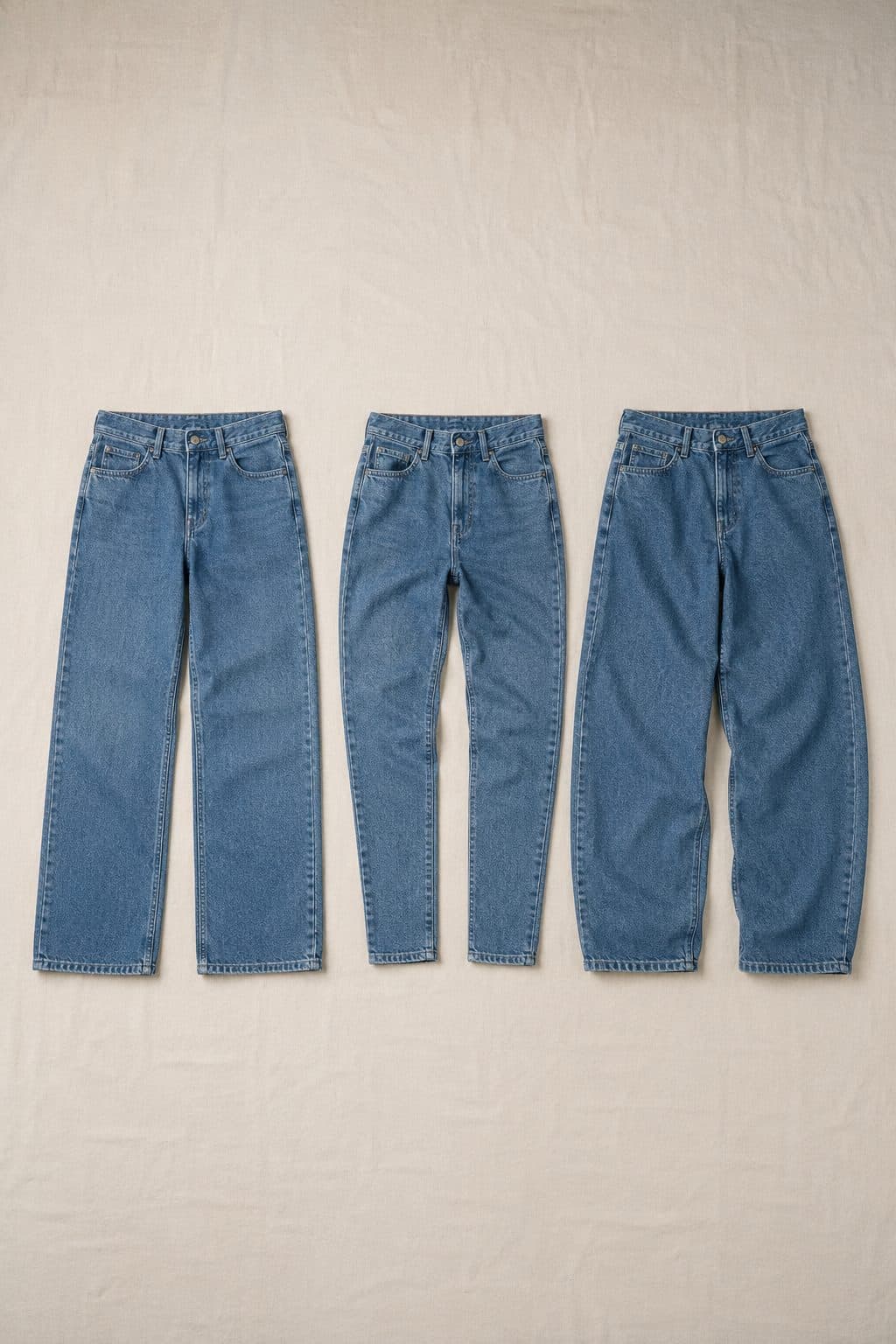
Every pair here is cut from one of three blocks and finished in one of six depths of indigo. Each one publishes the grade at which its indigo transfers onto other things, how much it shrinks, and seven measurements per size — before you pay, not after you complain.
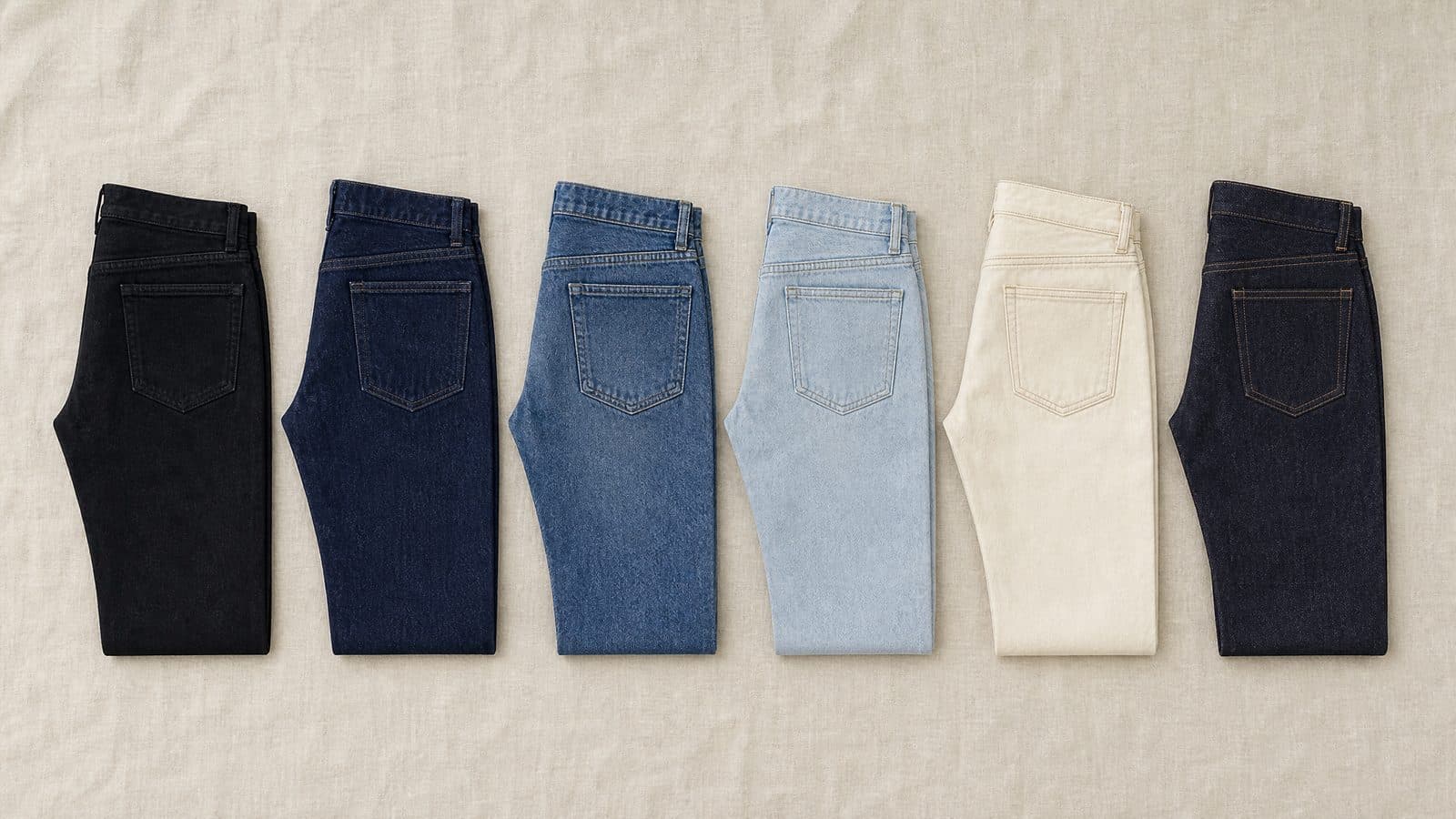
One block. The only thing that changes across the row is the indigo.
30
trouser styles
cut from three blocks
6
depths of indigo
rinse to undyed
1–5
transfer grade
published on every pair
Free standard shipping over USD 129 · prices in USD only · 14-day right of withdrawal
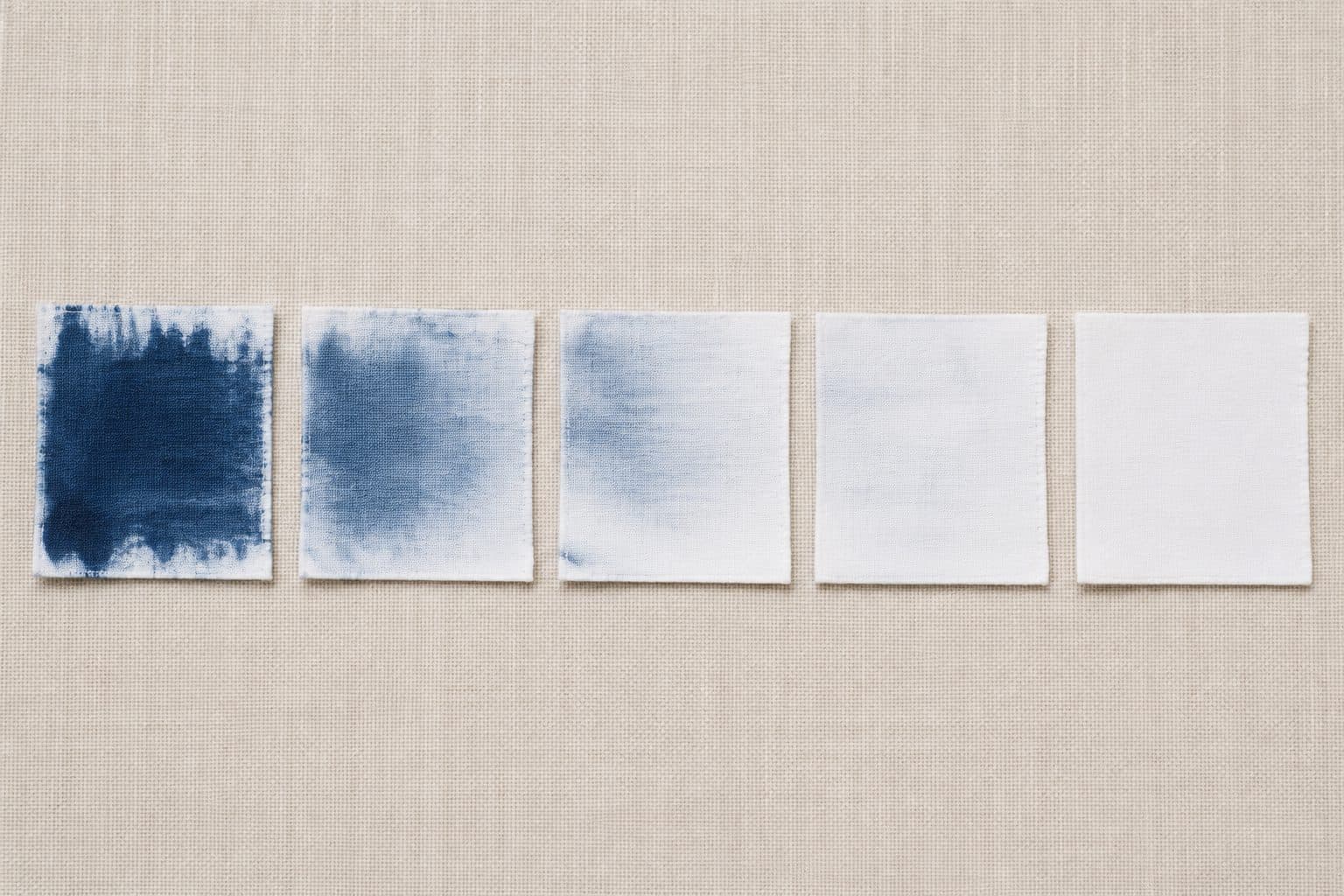
Five test cloths, rubbed against grade 1 through grade 5 cloth under ISO 105-X12
The second thing you see
Indigo sits on the outside of the yarn rather than inside it. On a deep pair it comes off on pale chairs, on bag straps, on the inside of light shoes and on your hands. Nearly nobody in this trade puts a number on it. We put it on the product page, on the matrix, in your bag and again at checkout.
How we test itHeavy transfer
Will transfer indigo onto light fabrics, bags and skin. Wash separately, and don't sit on a cream sofa in these for the first month.
Heavy transfer
Will transfer indigo onto light fabrics, bags and skin. Wash separately, and don't sit on a cream sofa in these for the first month.
Some transfer
Some transfer in the first few wears, mainly when damp.
Minimal transfer
Minimal transfer expected.
Minimal transfer
Minimal transfer expected.
Fit & wash matrix
Everybody else sorts denim by new arrivals, by gender, or by fit. None of those are what you are actually deciding between. You are deciding how dark to go, and what that costs you in transfer. Here is that decision, laid out.
Hover or focus a cell for its transfer grade, shrinkage and stretch
 A-01Straight RinseUSD 78Crock 2/5
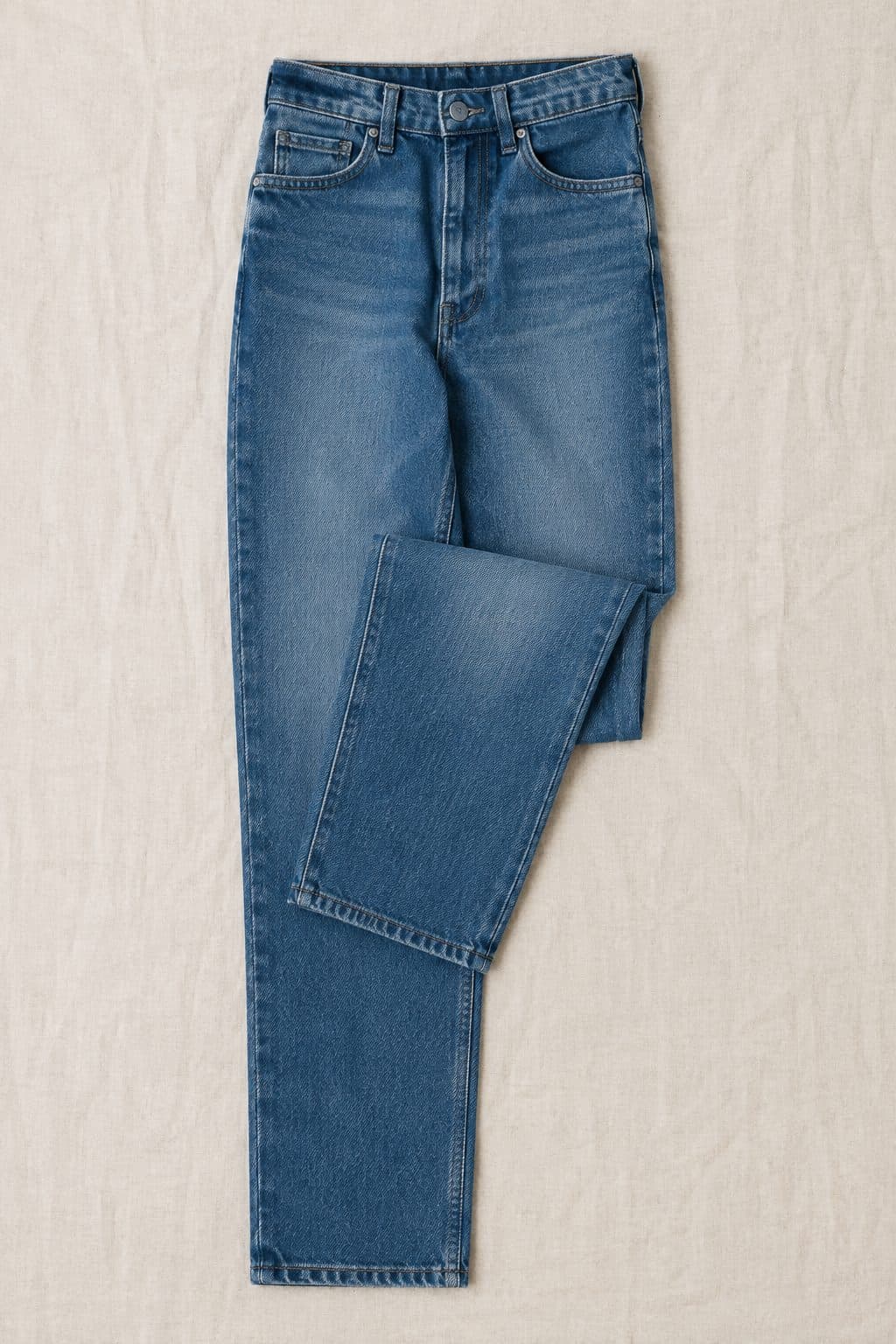 A-02Straight MidUSD 88Crock 3/5
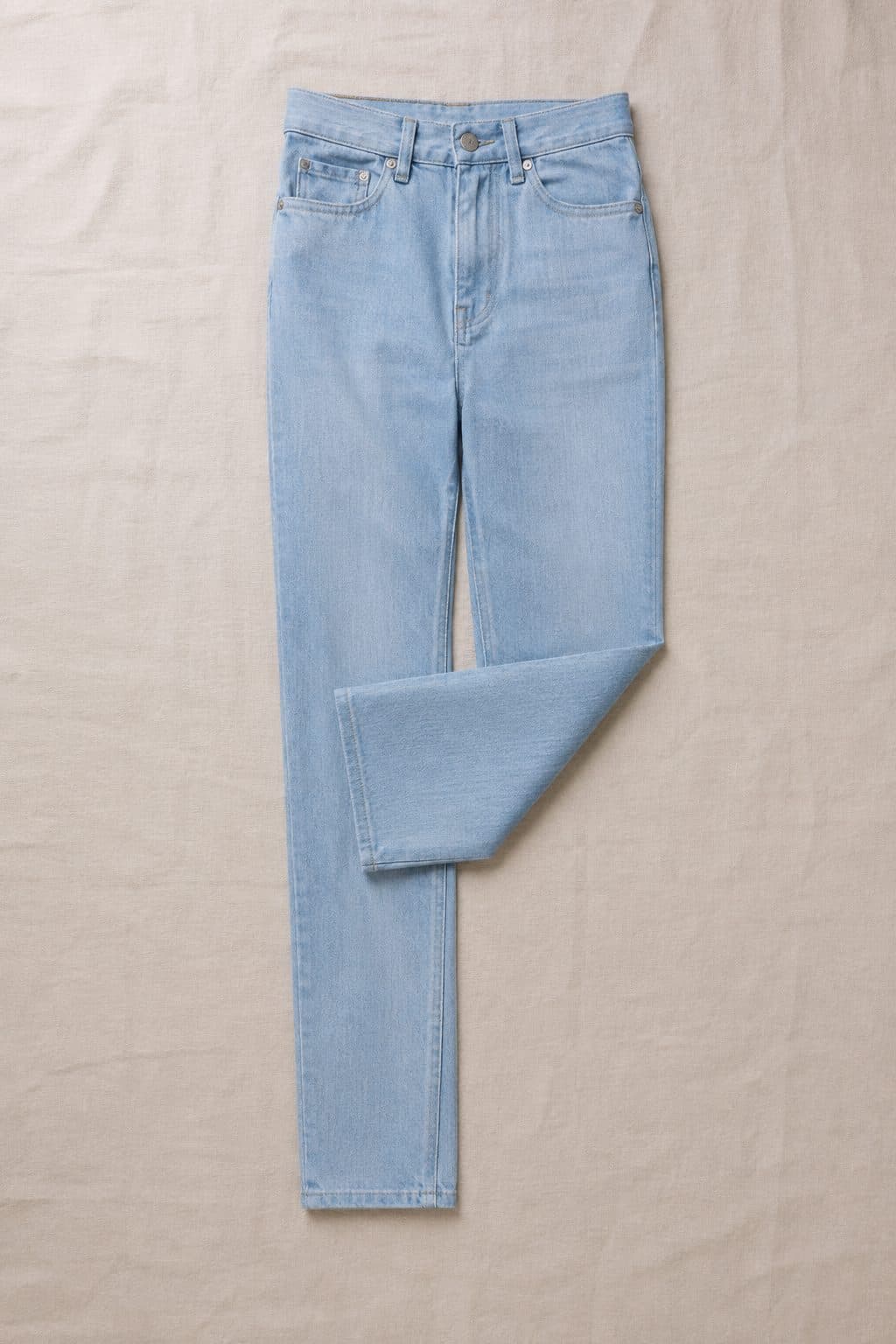 A-03Straight LightUSD 88Crock 4/5
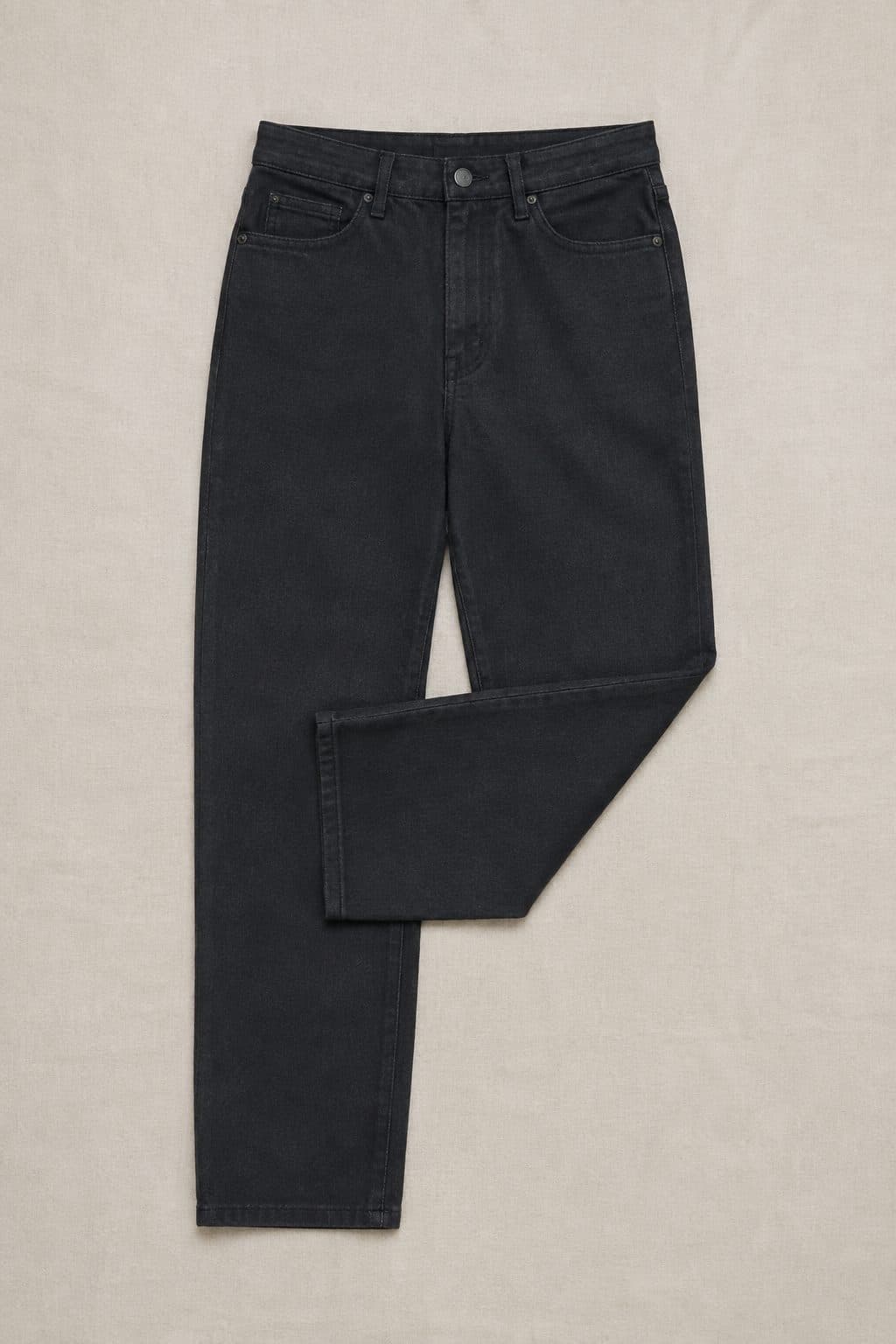 A-04Straight BlackUSD 92Crock 2/5
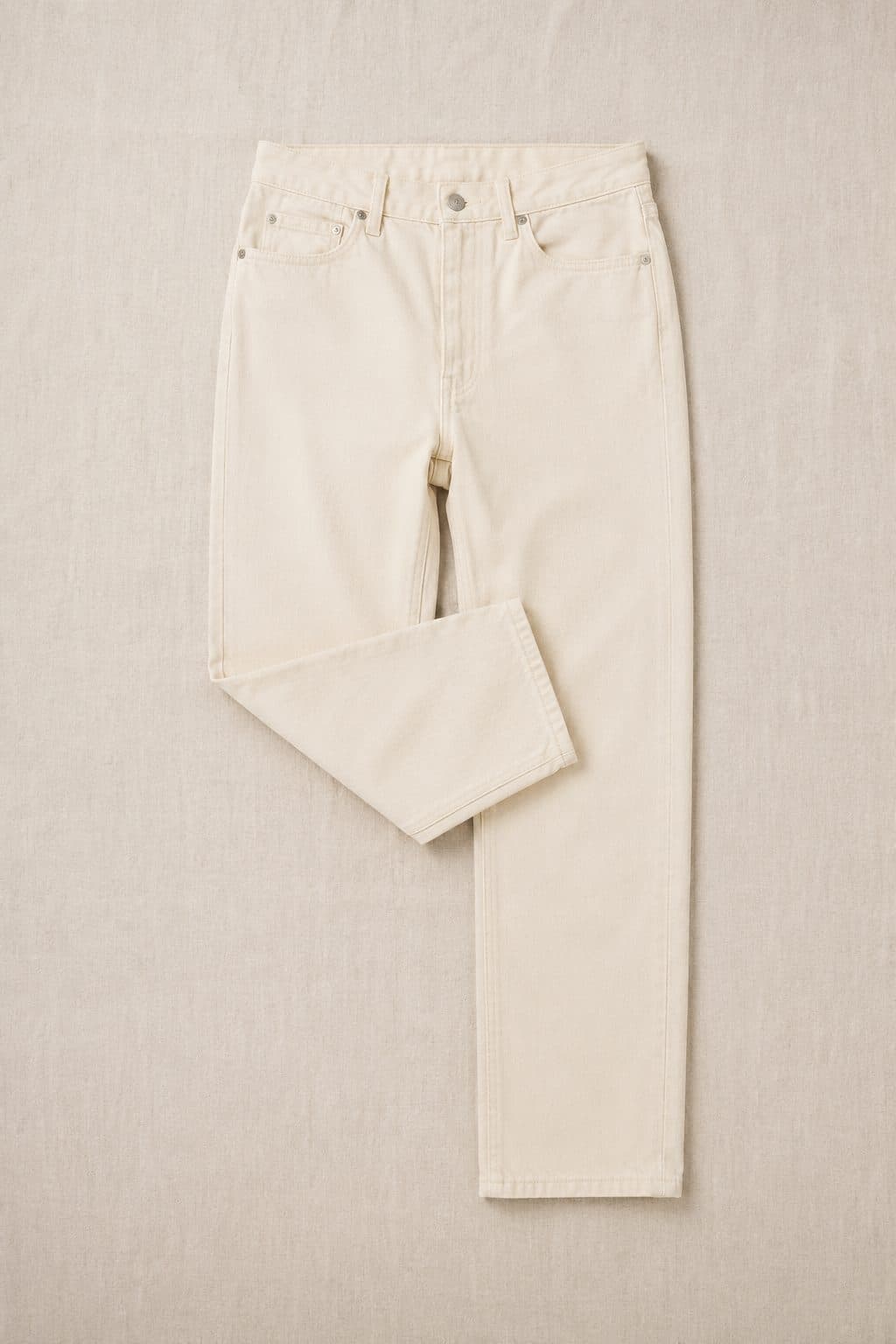 A-07Regular EcruUSD 108Crock 5/5
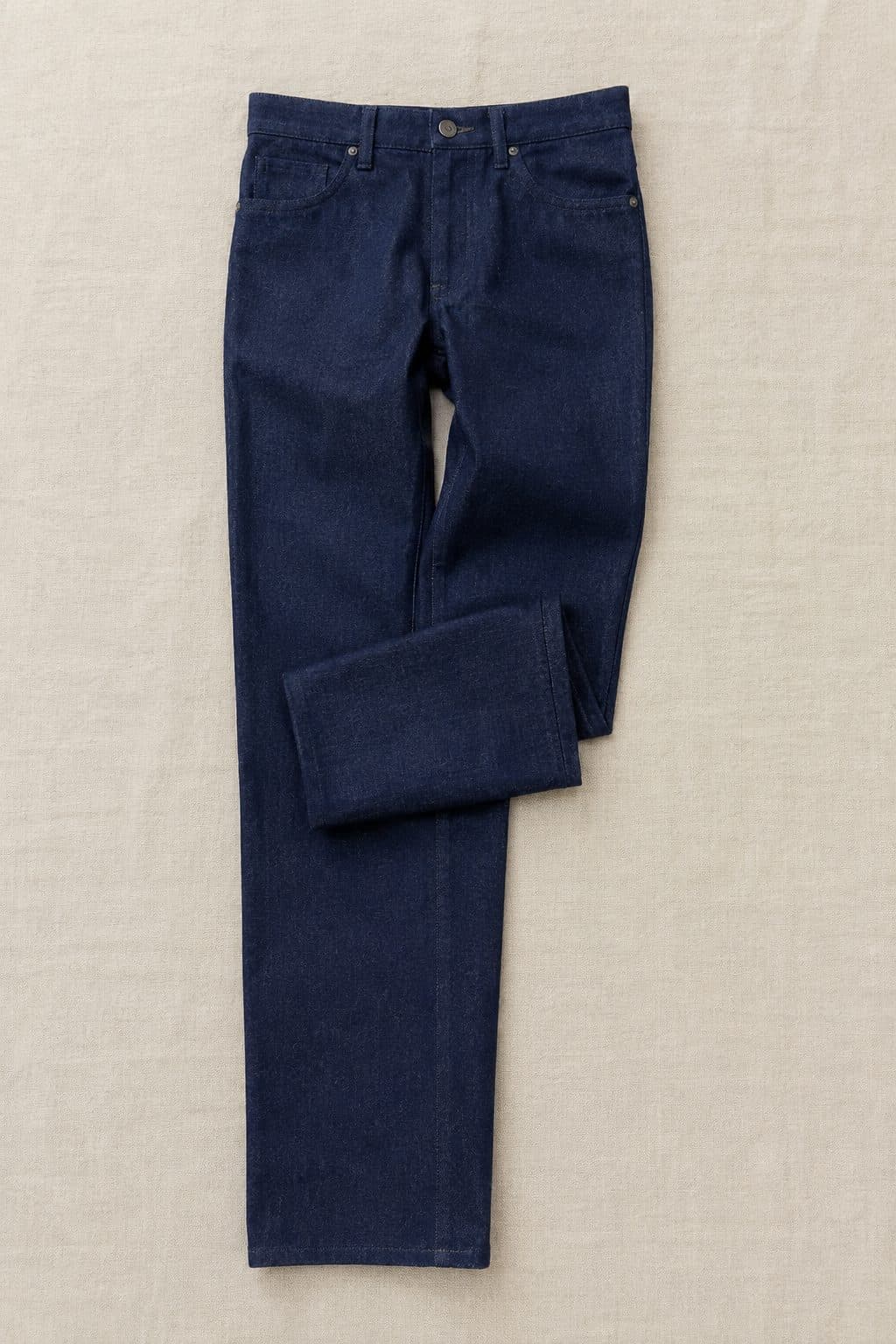 D-01Raw Straight 13ozUSD 148Crock 1/5
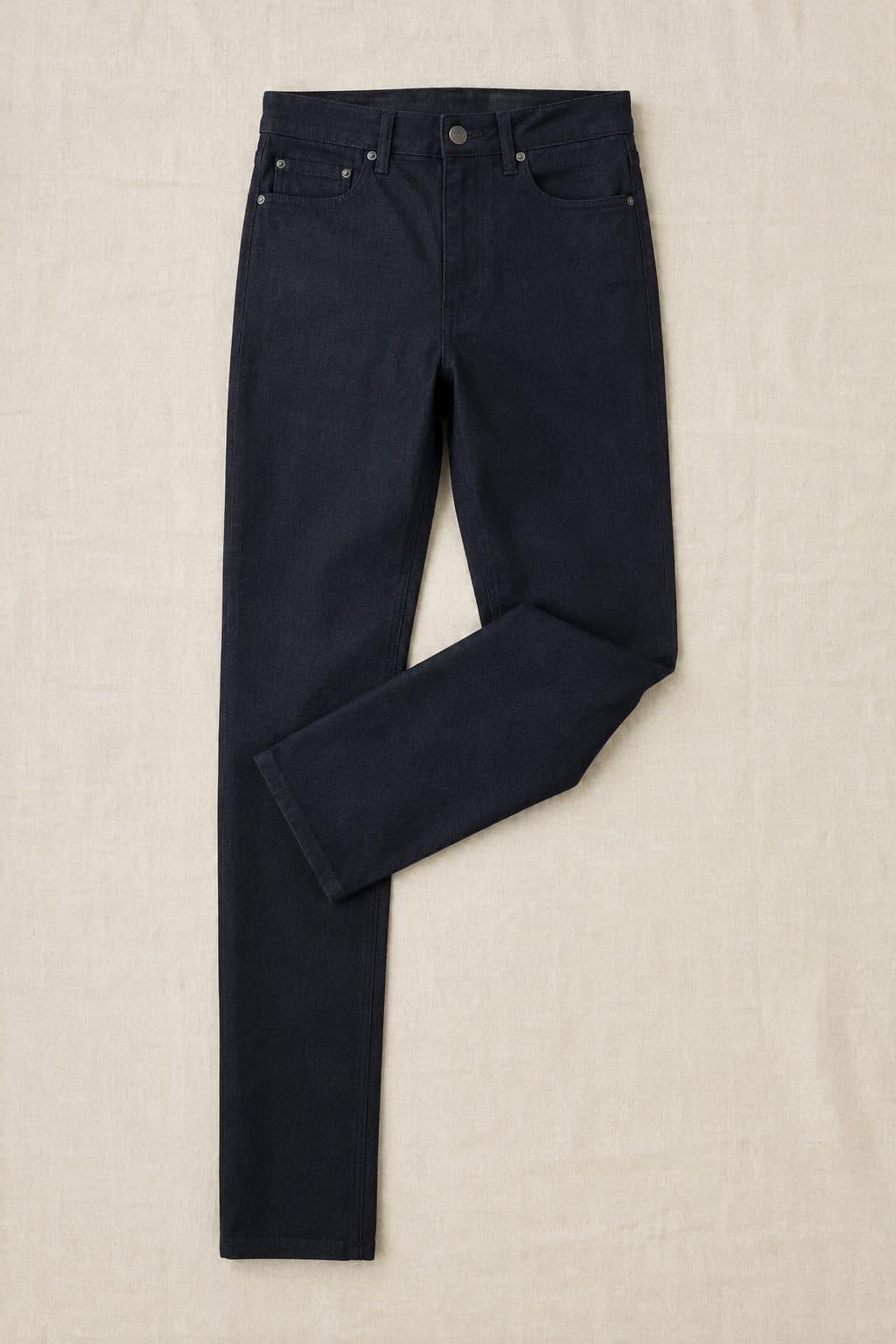 B-01Slim RinseUSD 82Crock 2/5
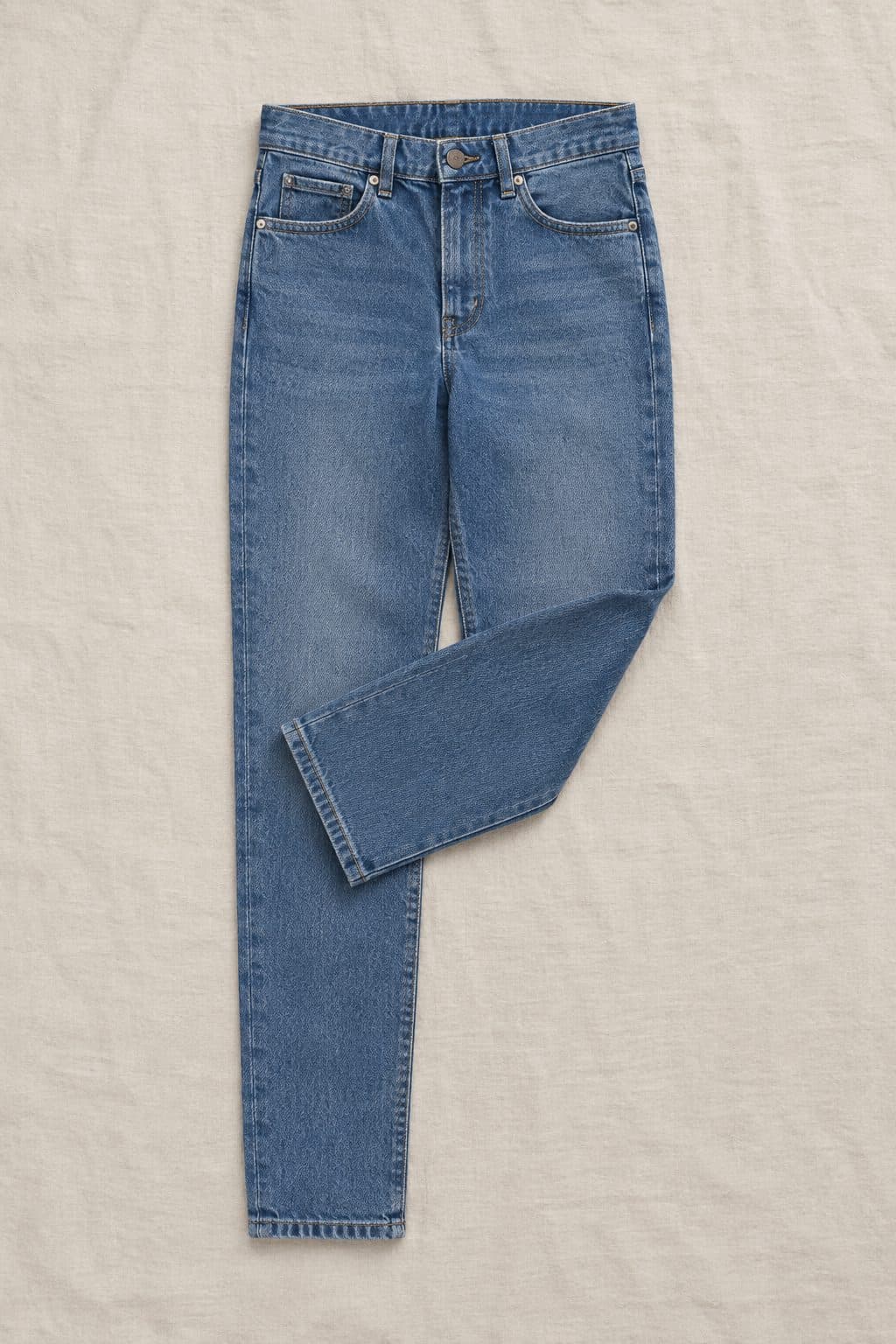 B-02Slim Mid StretchUSD 98Crock 3/5
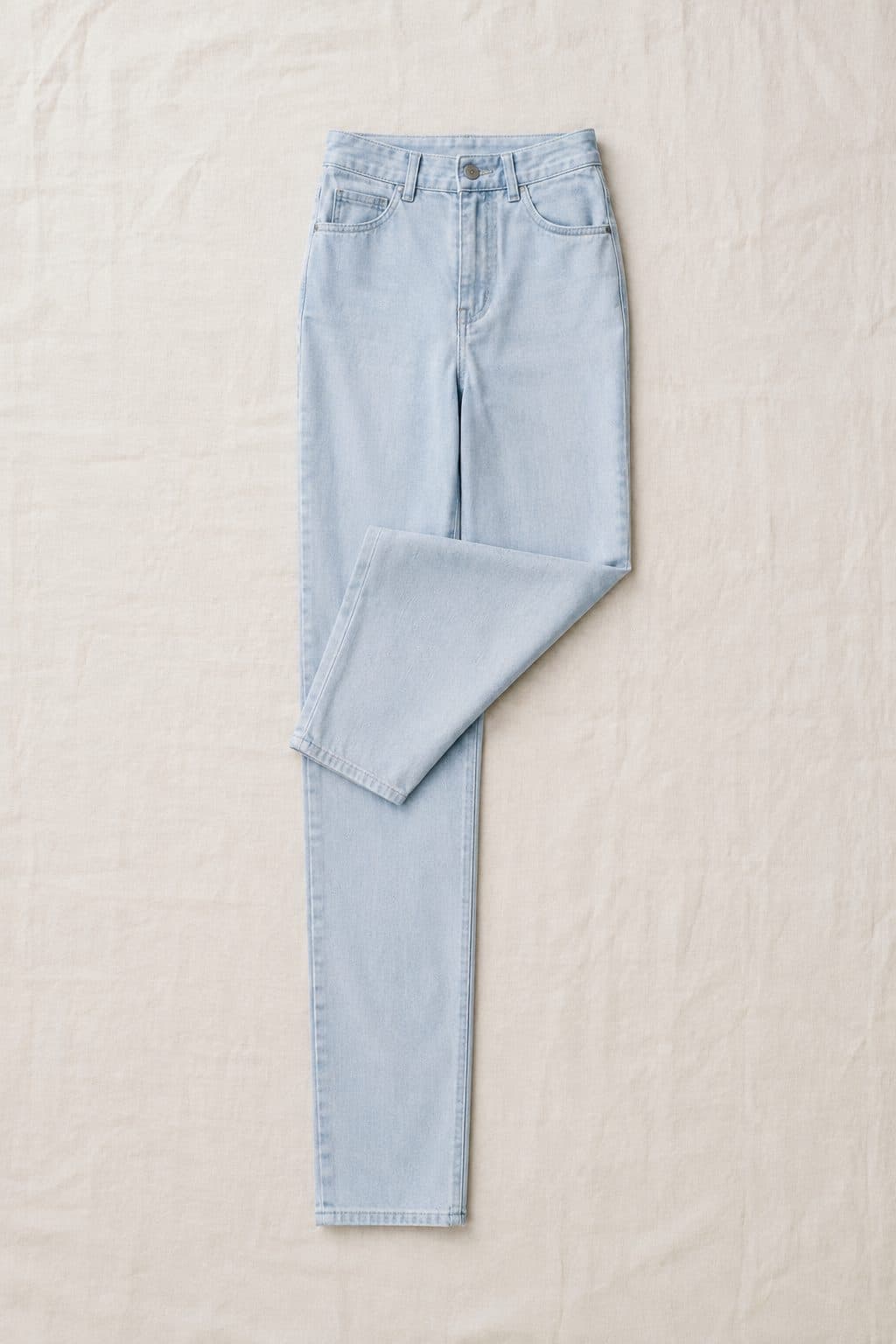 B-03Slim Light StretchUSD 98Crock 4/5
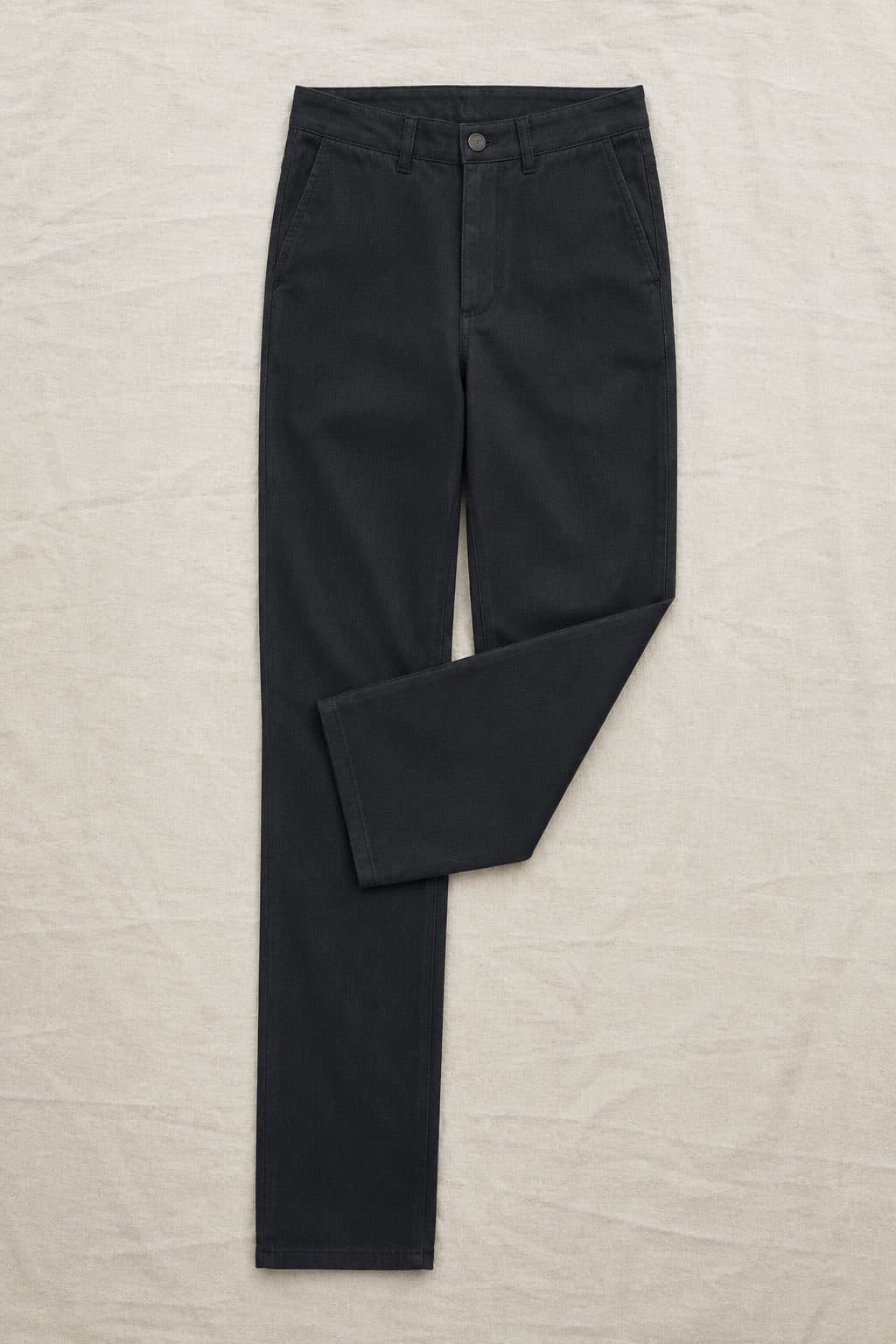 B-04Slim Black StretchUSD 102Crock 2/5
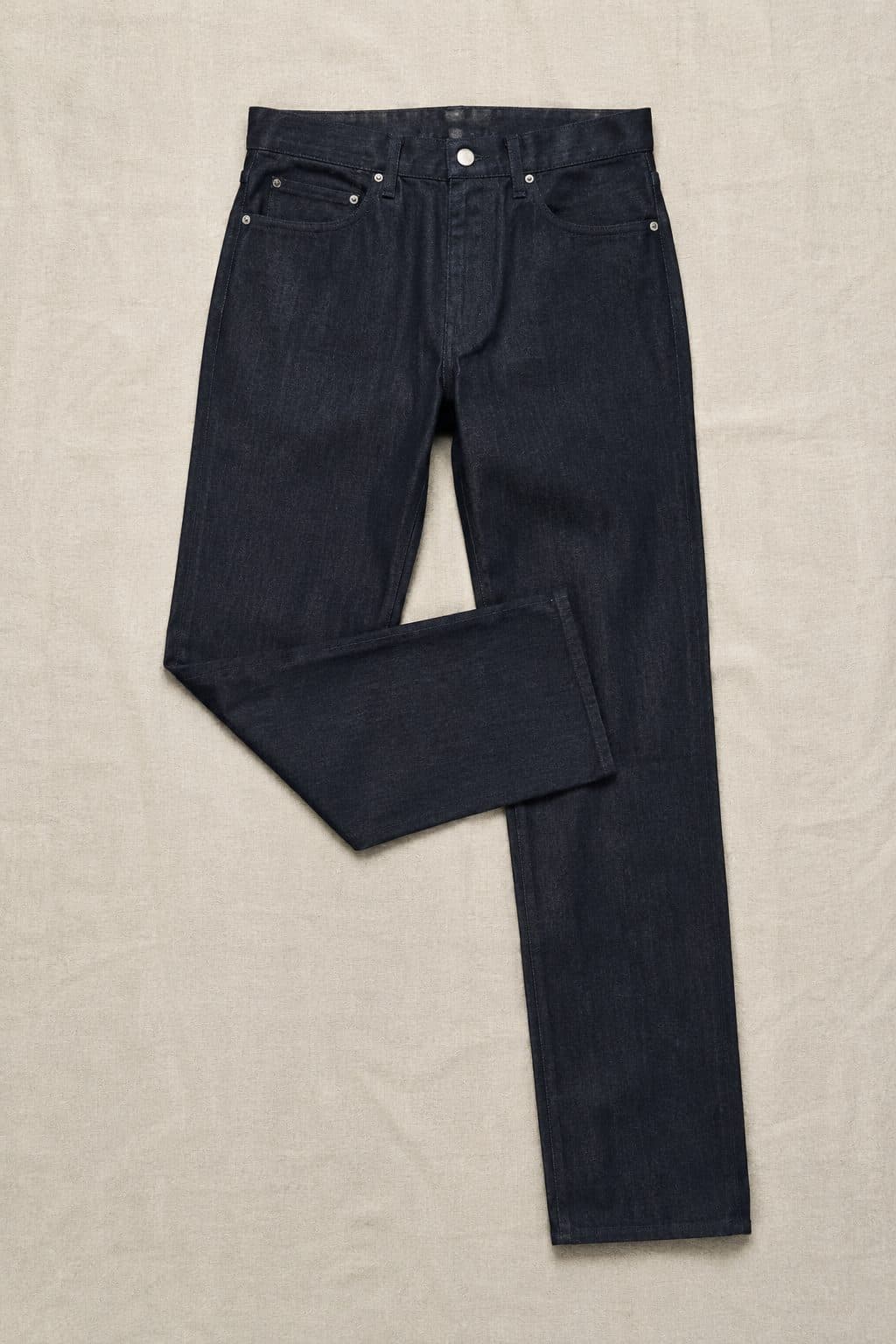 D-02Raw Slim 13ozUSD 148Crock 1/5
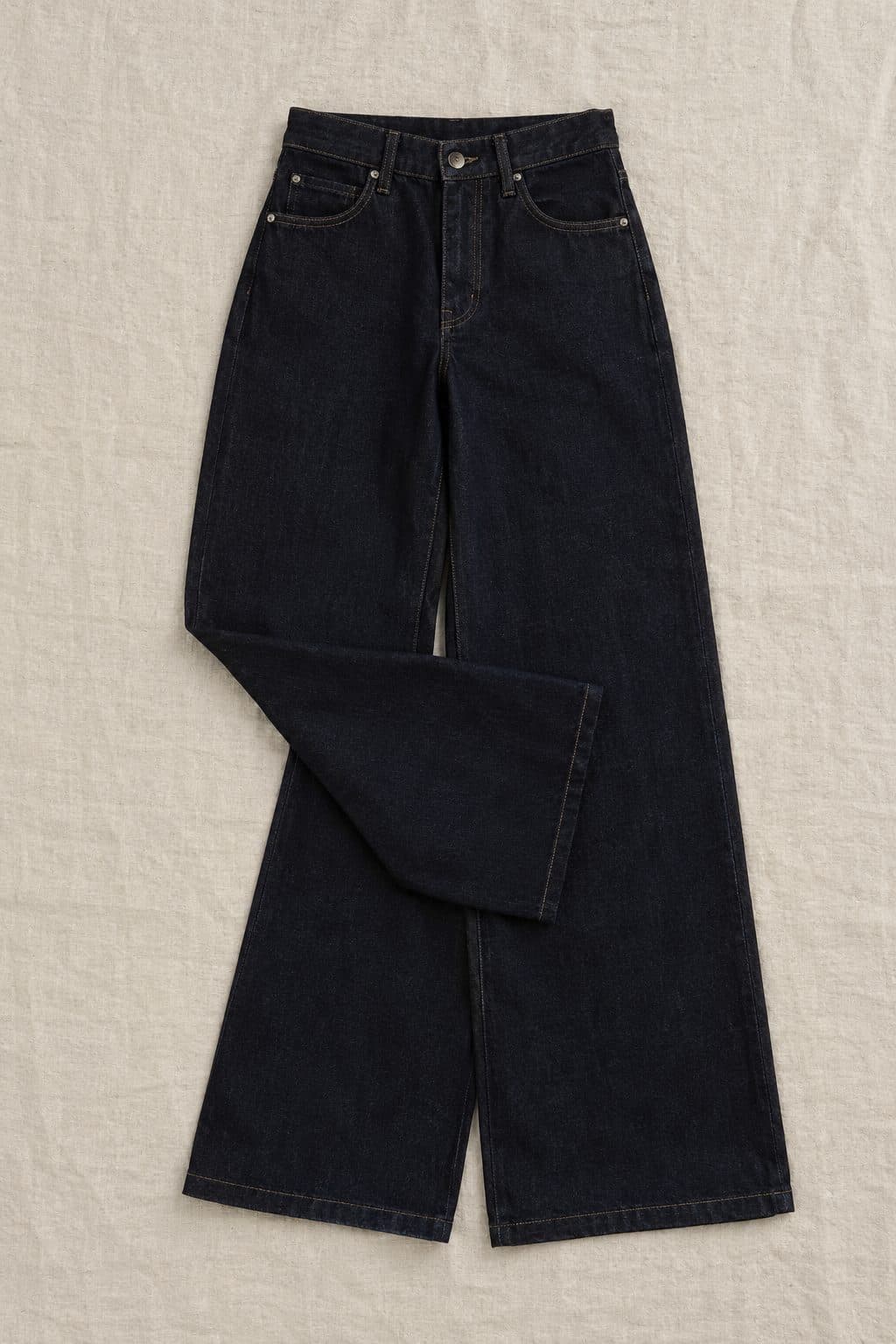 C-02Wide Leg RinseUSD 98Crock 2/5
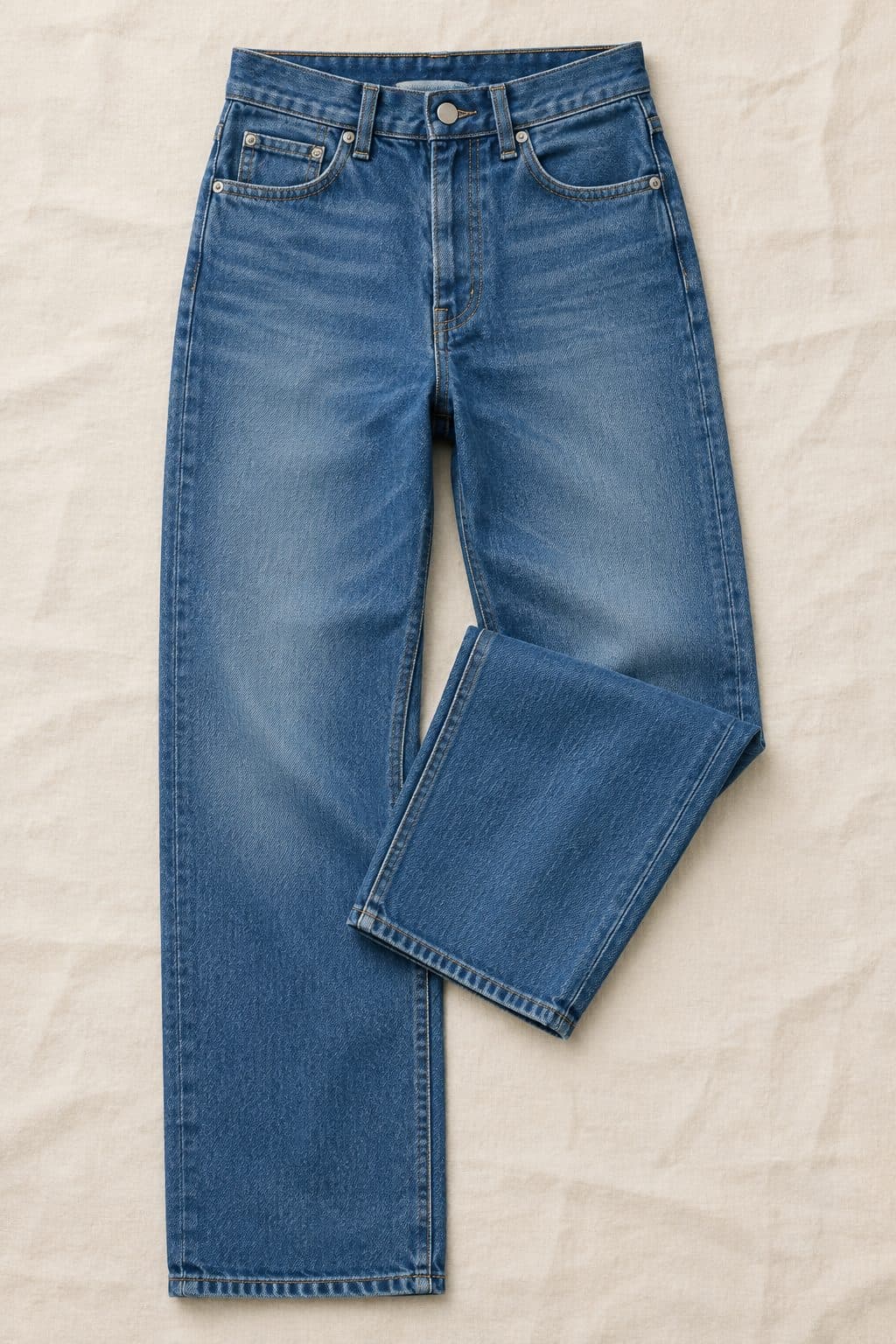 C-01Relaxed MidUSD 88Crock 3/5
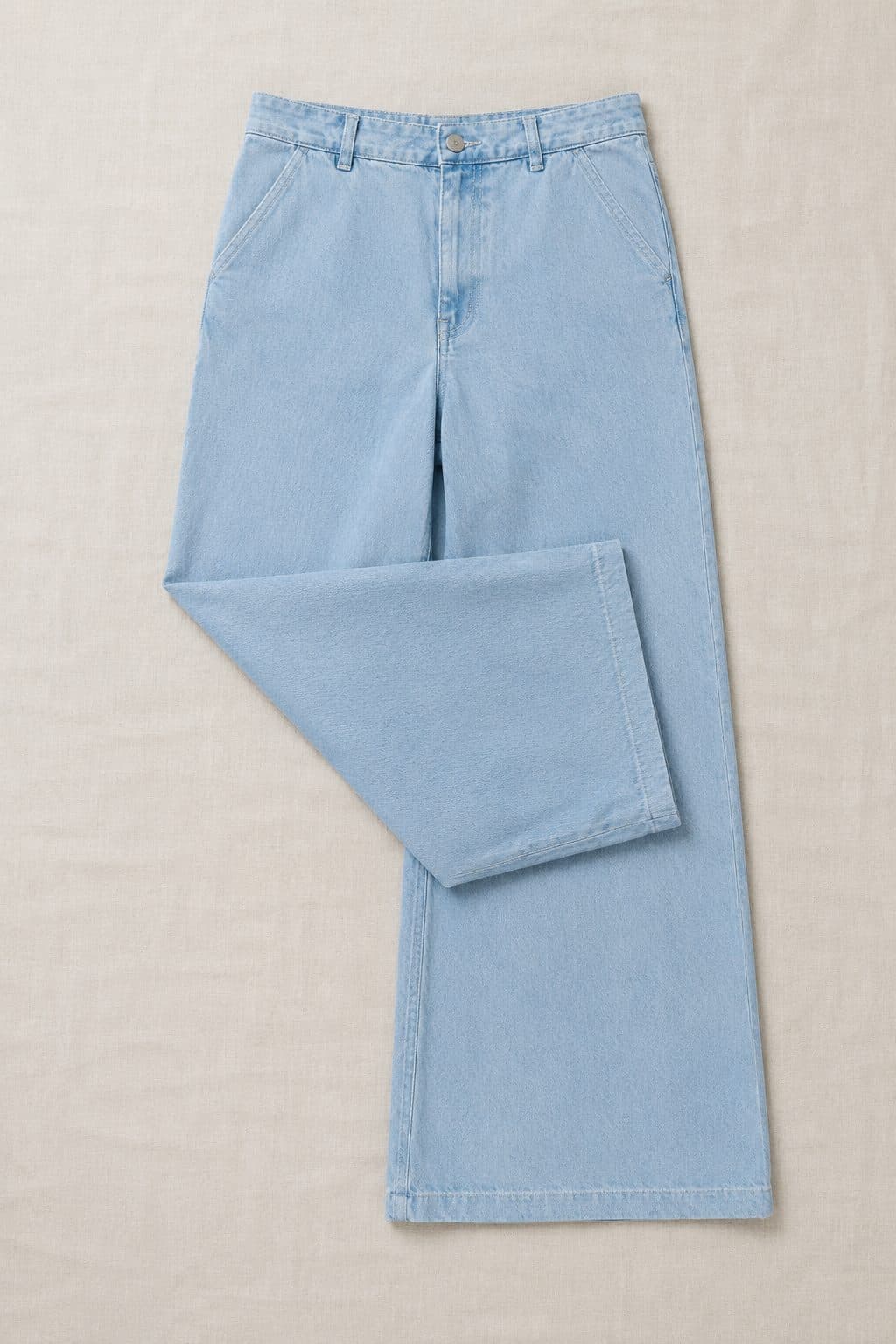 C-03Wide Leg LightUSD 98Crock 4/5
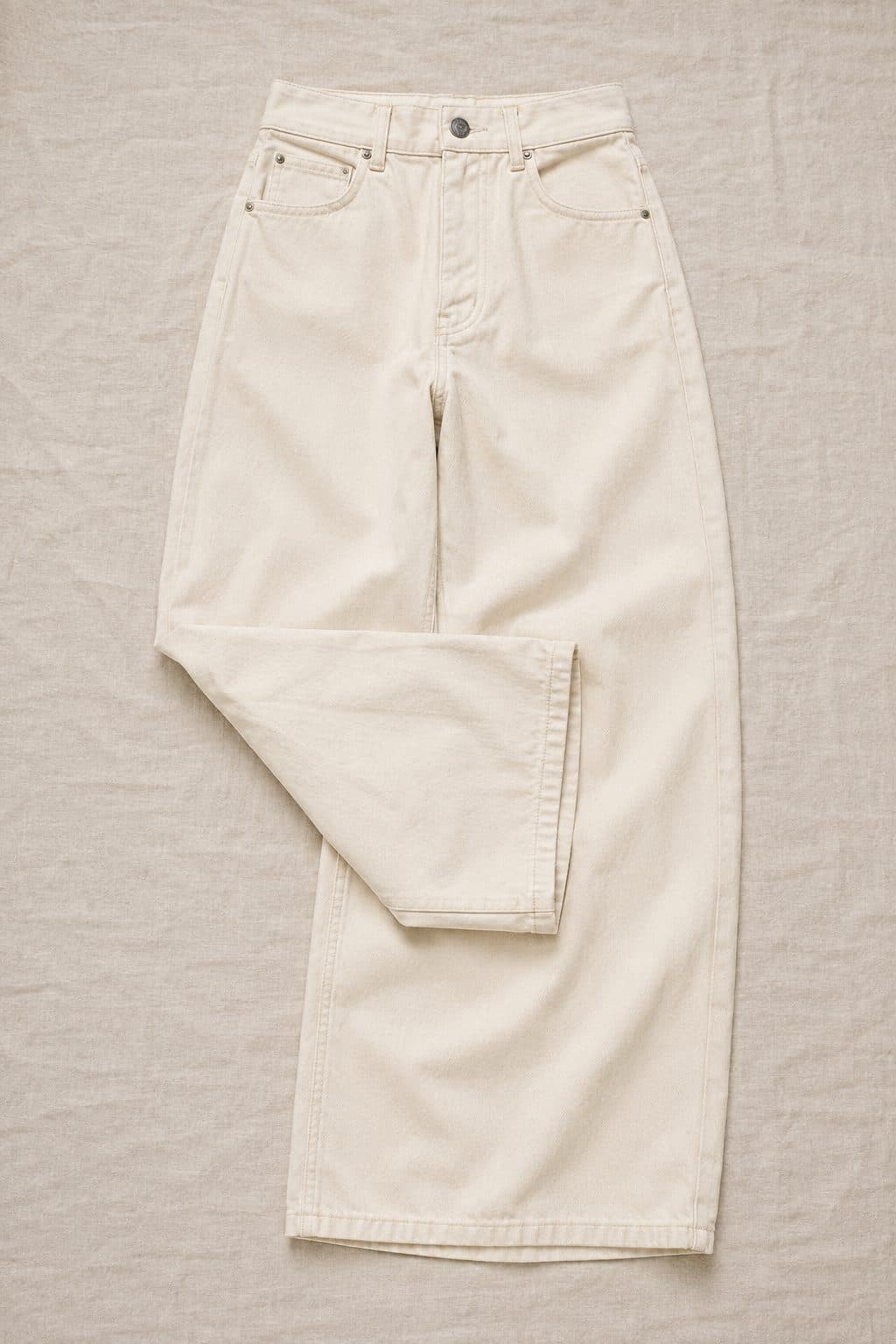 C-06Baggy EcruUSD 128Crock 5/5
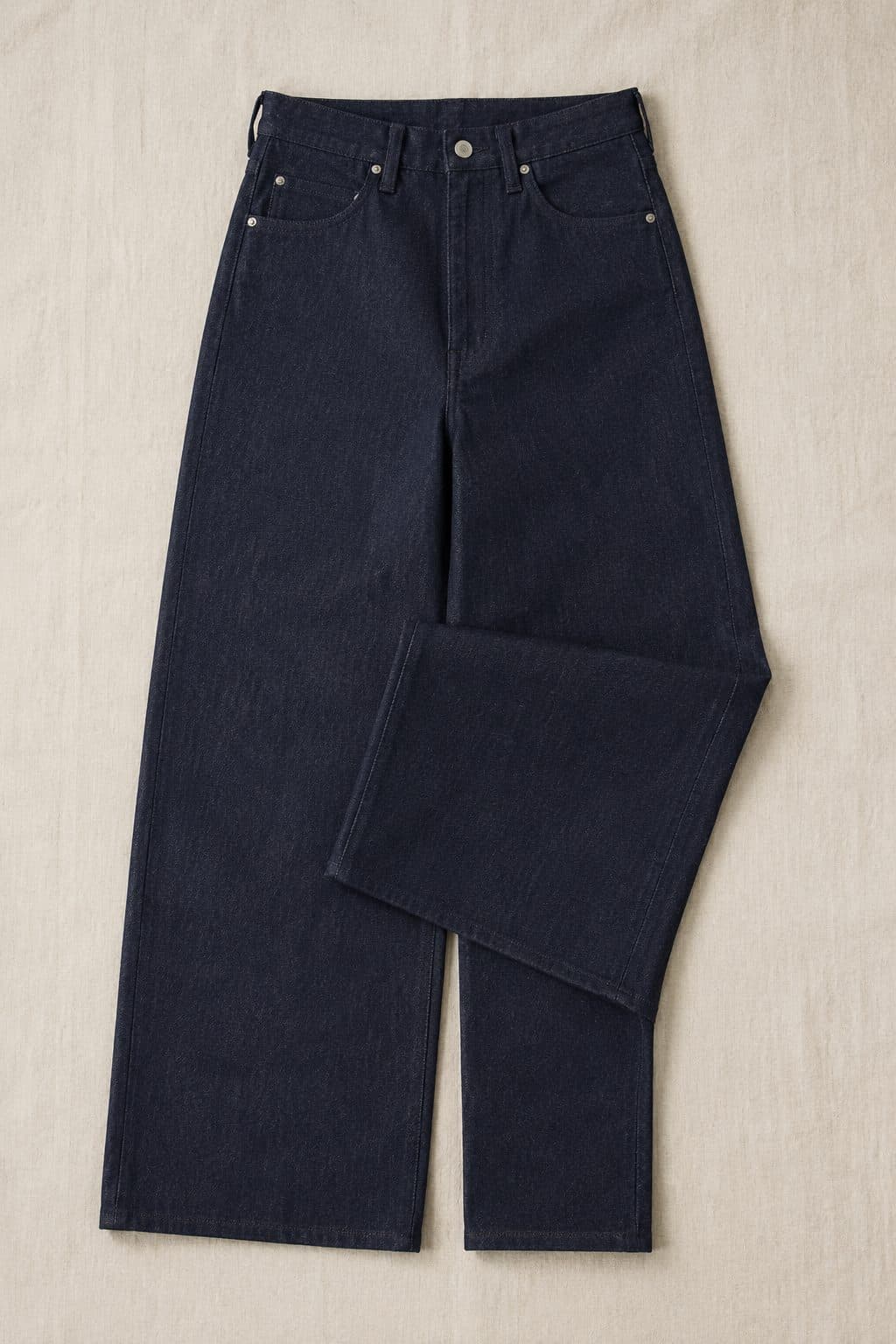 D-06Raw Wide 15ozUSD 178Crock 1/5
The block is the same across a row. Only the wash and the indigo change.
Two cells are empty because those trousers are not cut. Nothing has been substituted to fill them.
One block, six depths
Same waistband, same rise, same seat, same leg. The camera moves at a constant speed from the deepest indigo we run to the cotton that never went near the dye vat, so nothing about the comparison is flattered by an angle.
Silent looping footage of six pairs of denim trousers laid in a row on linen.
If you have not bought here before
Six lines
Lines A, B and C are the same trouser in three widths. Line D is the same trouser again in cloth that has never been washed. Line E is for the upper half and line F pairs the two.
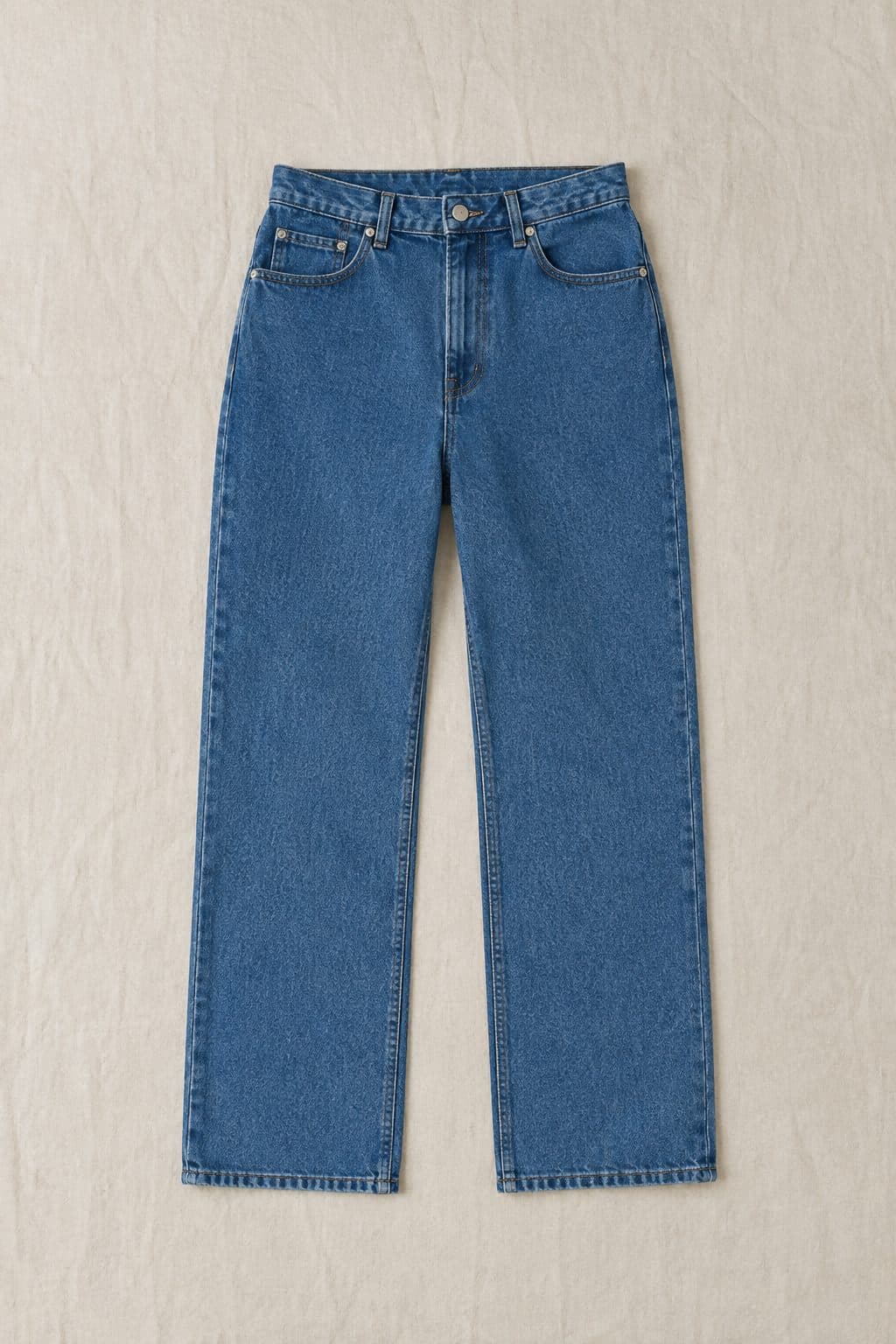
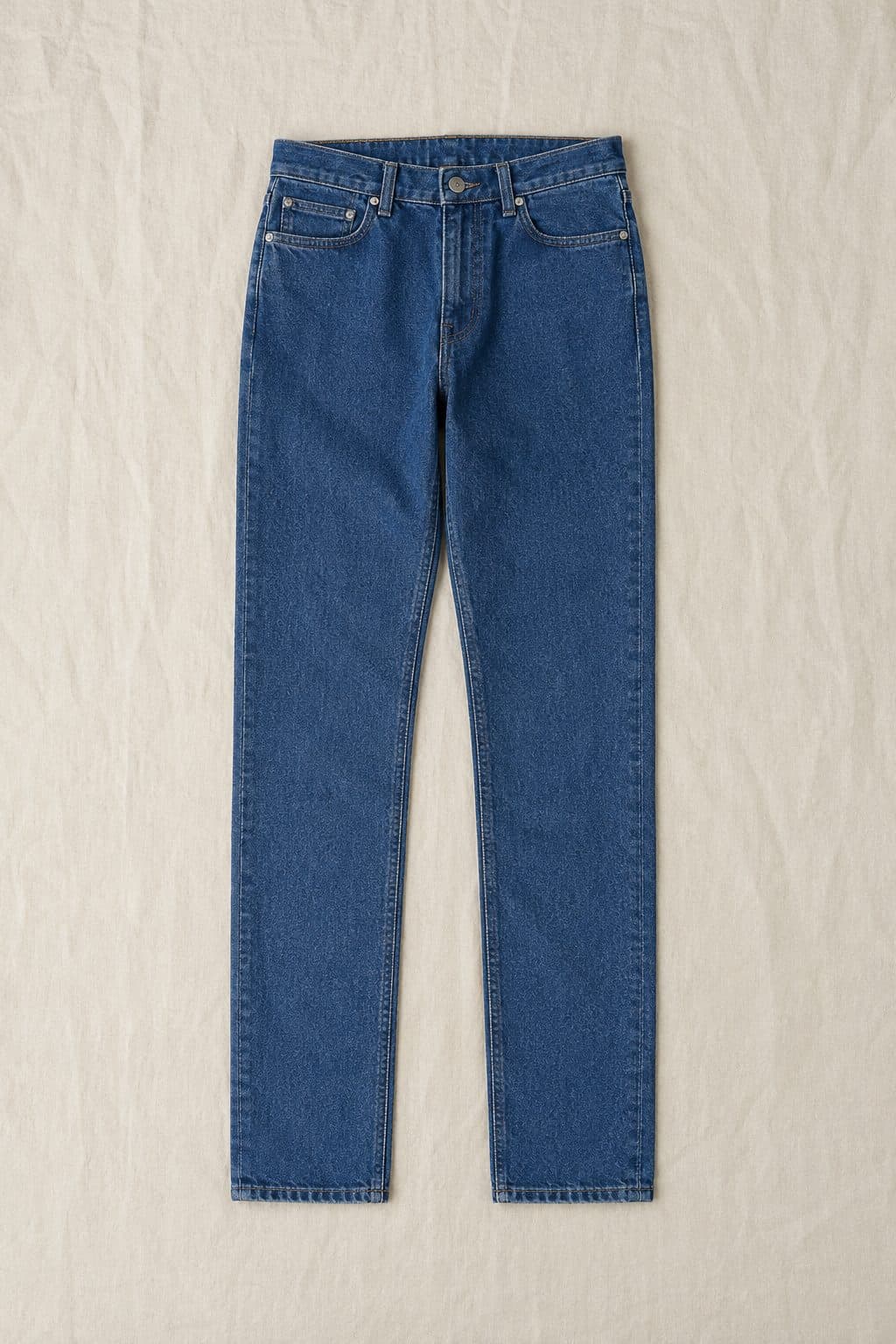
Line A · 8 styles
The reference block
One block, six depths of indigo. Start here if you want to know what the fabric does before you commit to a shape.
USD 78 – USD 188
Line B · 8 styles
Cut closer
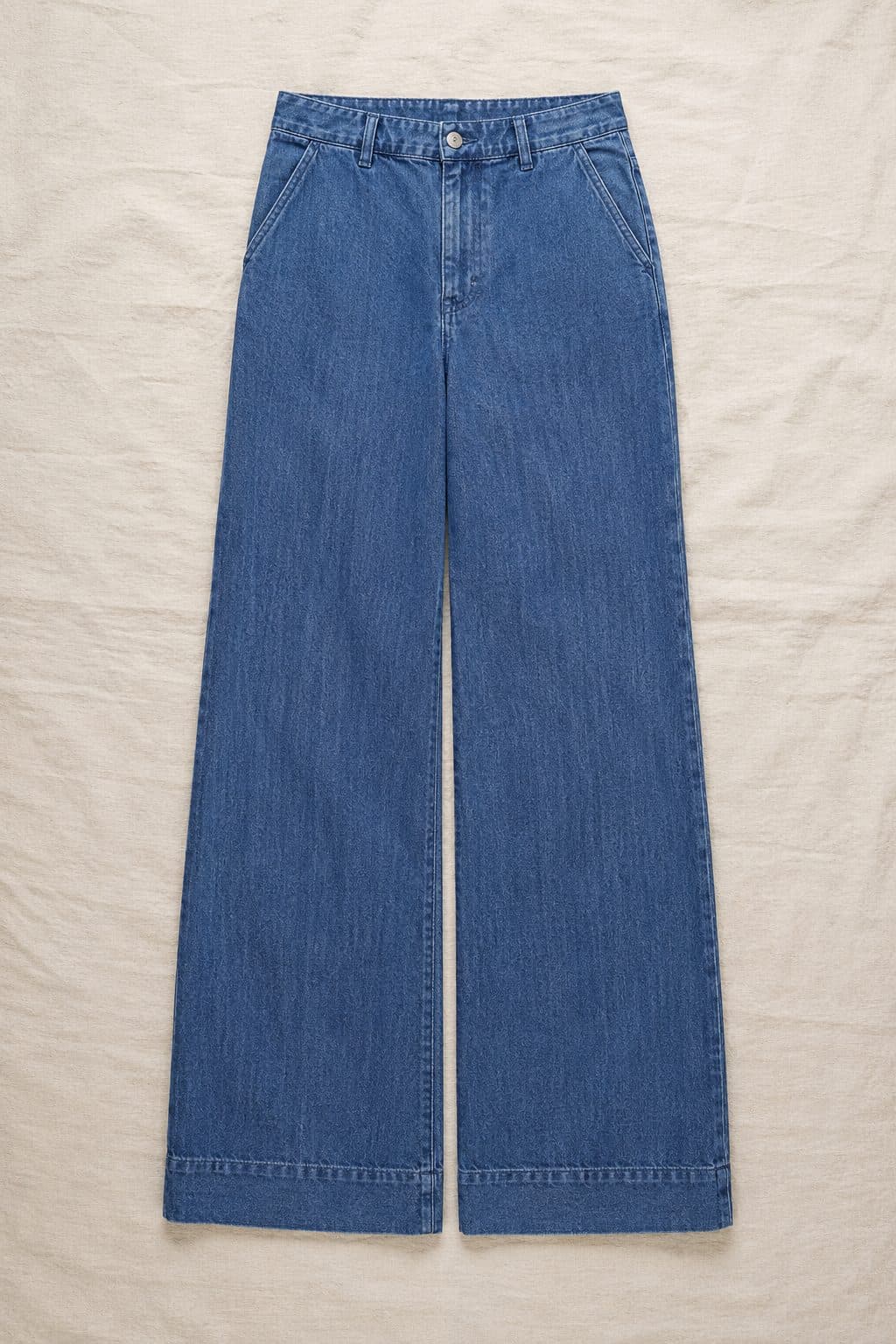
The same rise and the same seat, narrowed from the knee down. Most of this line carries elastane, and every gram of it is declared.
USD 82 – USD 178
Line C · 7 styles
Room through the leg
Full thigh, long drop, heavier cloth. The widest hems we cut, measured flat and published per size.
USD 88 – USD 168
Line D · 7 styles
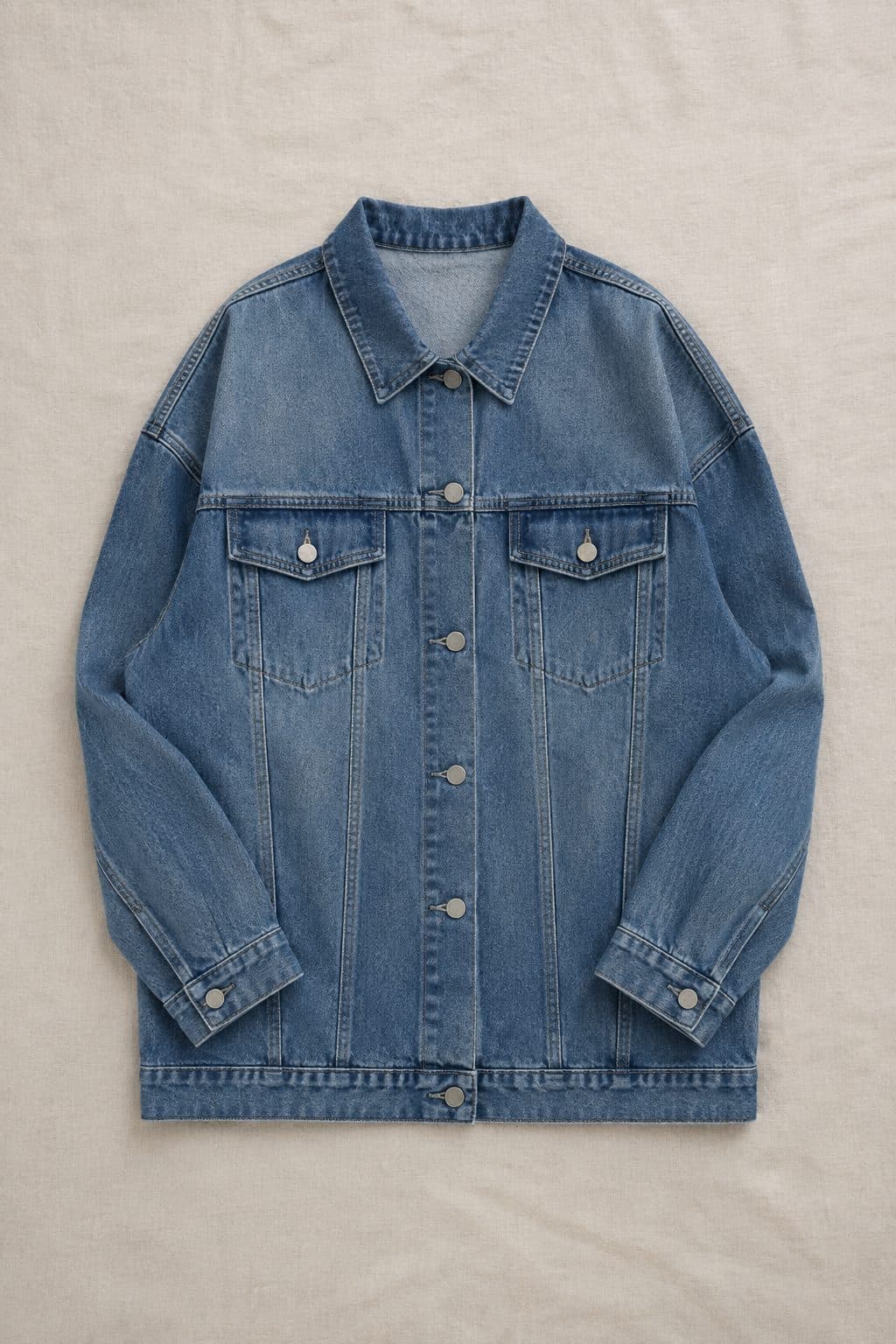
Unwashed, 13 to 21 oz
Never washed, so it will shrink and it will fade where you bend. Every pair states the shrinkage we expect in both directions before you buy.
USD 148 – USD 298
Line E · 7 styles
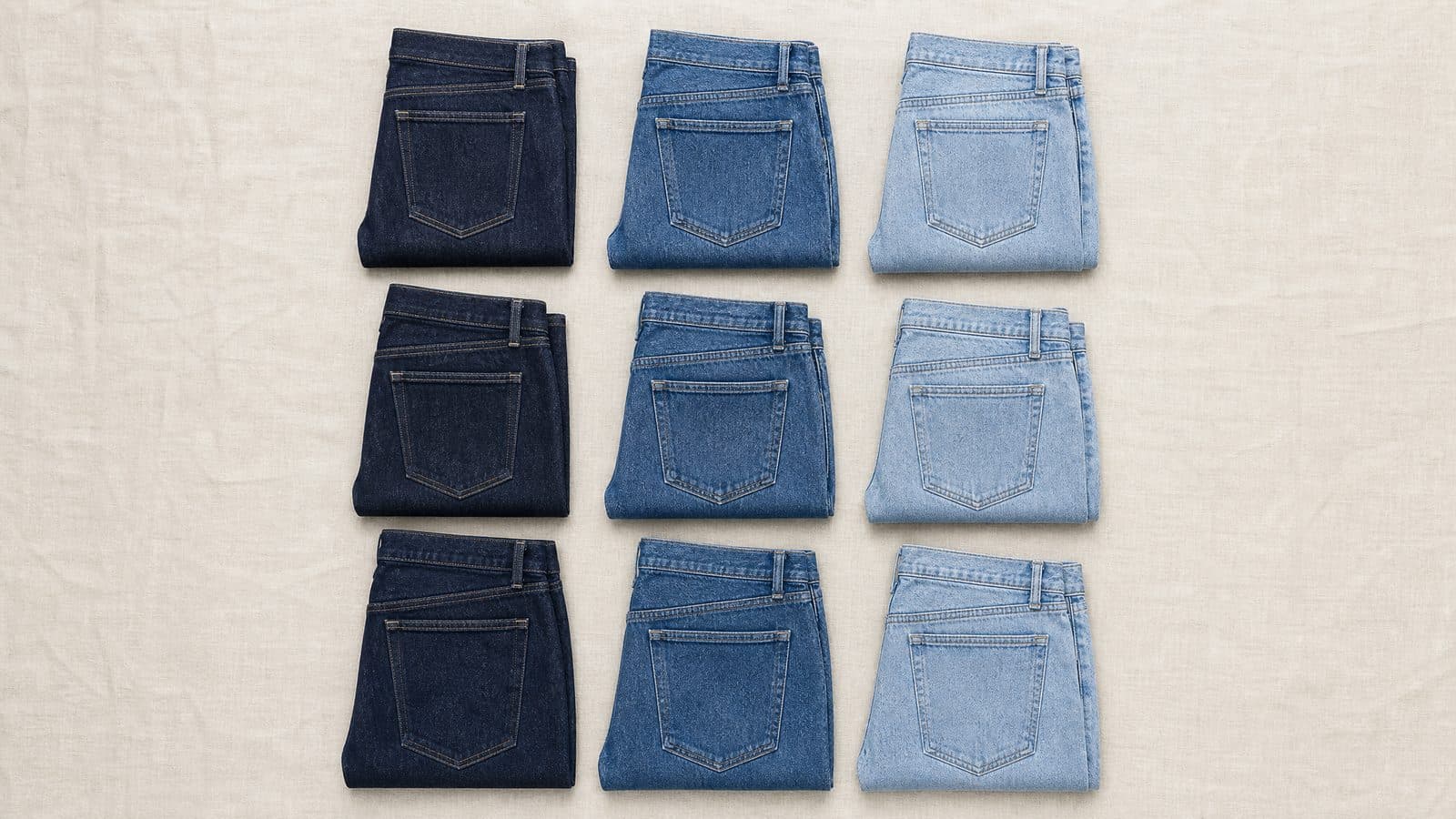
Jackets and shirts
The same six washes, cut for the upper half. Denim only — nothing in this line is made from anything else.
USD 98 – USD 248
Line F · 7 styles
Paired by wash
Two or three pieces chosen so the washes work next to each other, priced below the sum of the parts.
USD 158 – USD 428
Unwashed denim, over time
Line D leaves the factory the way it left the loom. We do not put a worn pattern on it, and we do not pretend one is already there. What follows is what actually happens, in the order it happens.
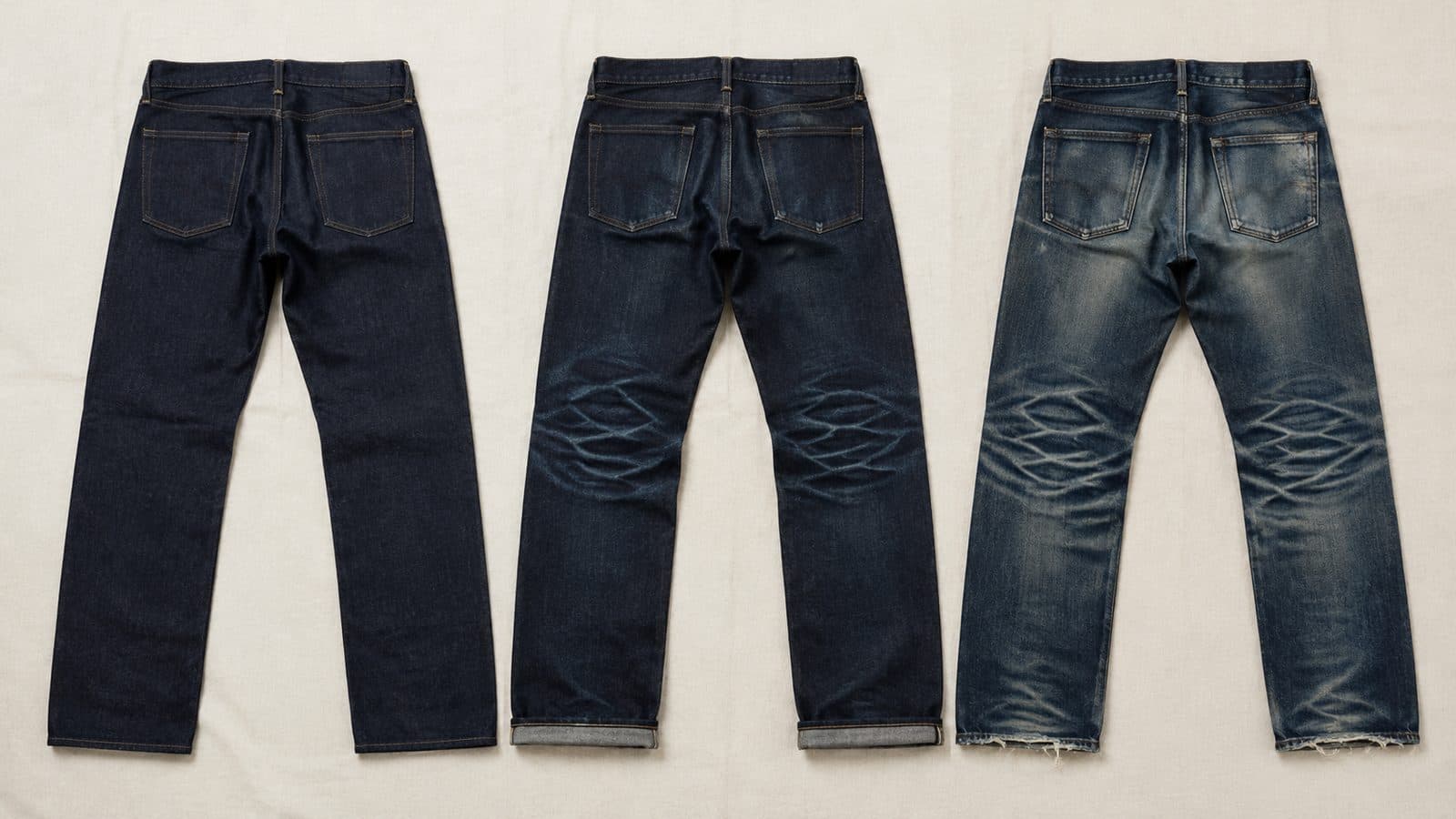
Day 0
Unwashed cloth arrives hard enough to stand up on its own. It is cut long on purpose, because the first soak takes 4 to 5 per cent out of the length and 2.5 to 3 per cent out of the waist. Do not hem it yet.
Month 3
Pale lines appear behind the knee and at the hip, where the cloth folds the same way every day. This is abrasion, not damage, and it is the reason the trousers will not look like anybody else's.
Year 1
The seat and the thighs have gone several shades lighter, the hem has frayed where it meets the floor, and the indigo that was going to come off has come off. Transfer is no longer something you have to plan around.
The rub test, on film
ISO 105-X12 is not complicated: a standard cotton cloth is rubbed across the surface ten times, dry and again wet, and the stain it picks up is read against a grey scale. The number that comes out of it is the number on every product page here.
Silent looping footage of a white test cloth being rubbed across dark denim and lifted to show the indigo it has picked up.
On every product page, without exception
01
A number from 1 to 5 with the test method named next to it, and the fixed sentence that goes with that band.
02
Ounces per square yard, the fibre names in Italian and English, and the elastane percentage where there is any.
03
Unwashed pairs state expected loss in length and in waist. Pre-washed pairs state what is left to lose.
04
Anything with elastane in it states how far the waist opens over an hour of wear and what happens after a wash.
05
Enzyme wash, stone wash, laser etch, hand rub, or none at all. Never sandblasting — see the statement below.
06
Where the cloth was woven and where the garment was made, as two separate facts.
07
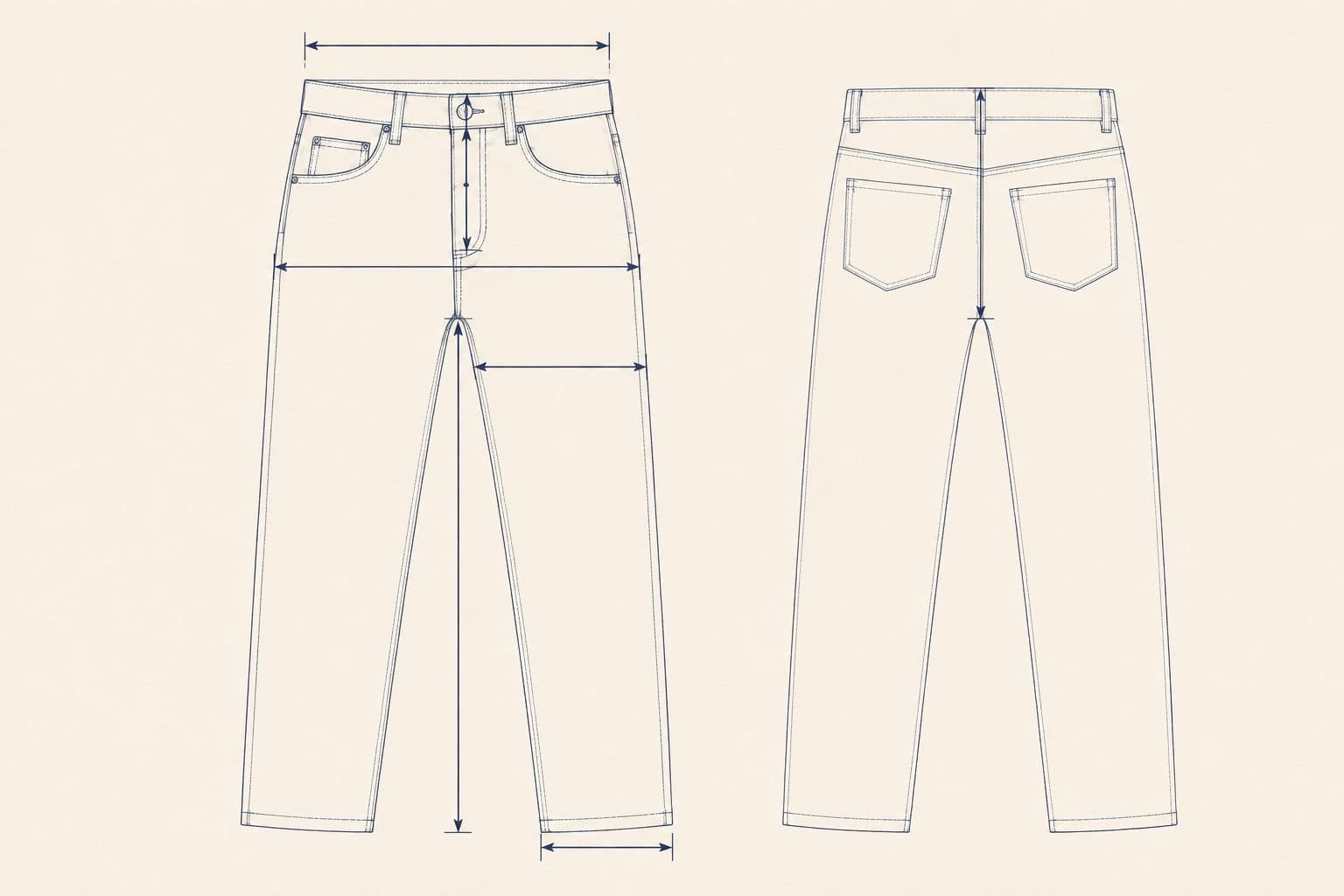
Waist, hip, thigh, front rise, back rise, inseam and leg opening, taken flat, listed for every size we cut.
08
The height and weight range of the person in the measurements, and the size they have on.
If any one of these is missing from a product record, that product does not appear on this site at all. That is enforced in the code, not in a policy document. Read how the checks work.
The stitch on the back pocket, what the first wash has to be, and what happens after it. All three are on every product page too — this is just where they are easiest to see.
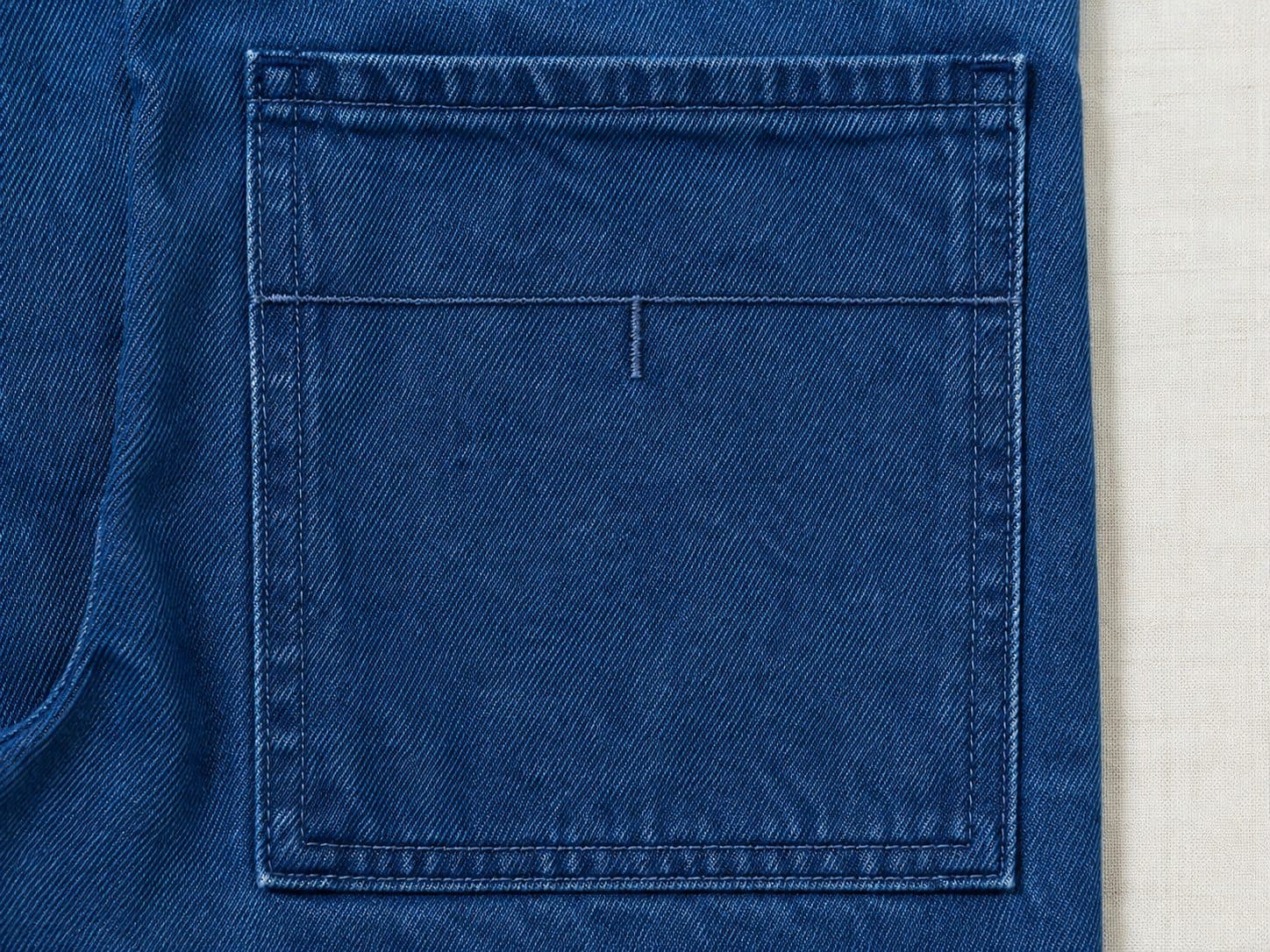
The stitch
A single straight line across the pocket with one short tick dropped from its centre, in thread the same shade as the cloth. No arcs, no wings, no chevrons — deliberately, because those shapes belong to other people. Nothing on this site imitates another maker's mark, carries a licensed character or borrows a registered trade mark.
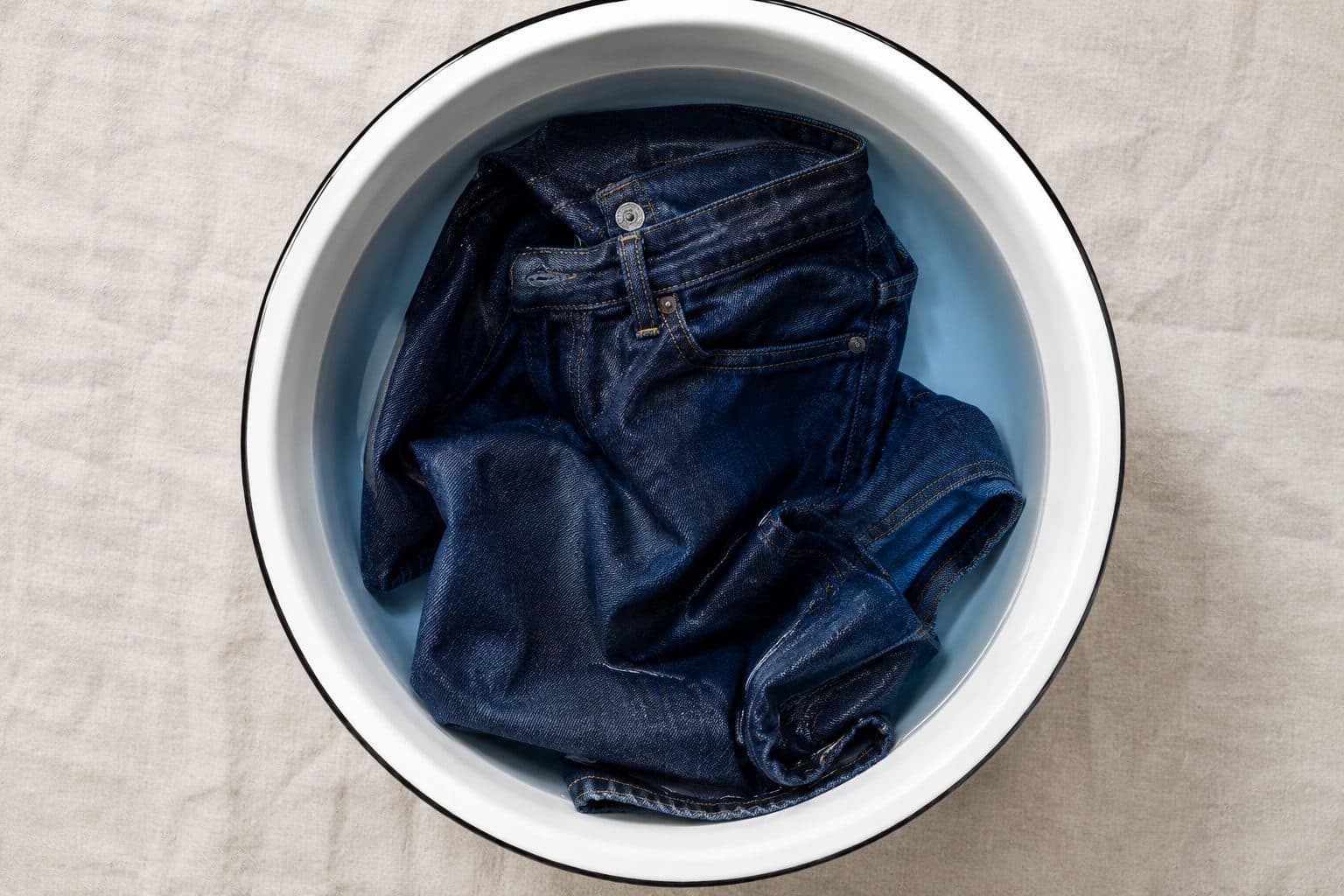
The first wash
Anything graded 1 to 3 for transfer goes in the drum by itself the first time. This is not a suggestion buried in a care label — it is printed on the product page, and again at checkout when it applies to your order.

After that
Turn it, wash it at 30 °C, hang it. Never tumble dry anything from this site — heat is what takes the length out of cloth that had none left to give.
Everything on this page is repeated where it actually matters — on the product record itself. The full reference has the test methods, the shrinkage table and the process statement.
A process we do not use
Blasting denim with abrasive grit to fake wear puts silica dust into the lungs of the person holding the gun. It causes silicosis, and it is prohibited in the European Union. Nothing we sell has been through it.
Where a pair has been abraded at all, the process is named on its page: enzyme wash, stone wash, laser etch or hand rub. The field is mandatory, and a record that names a blasting process cannot be published at all.
The full process statement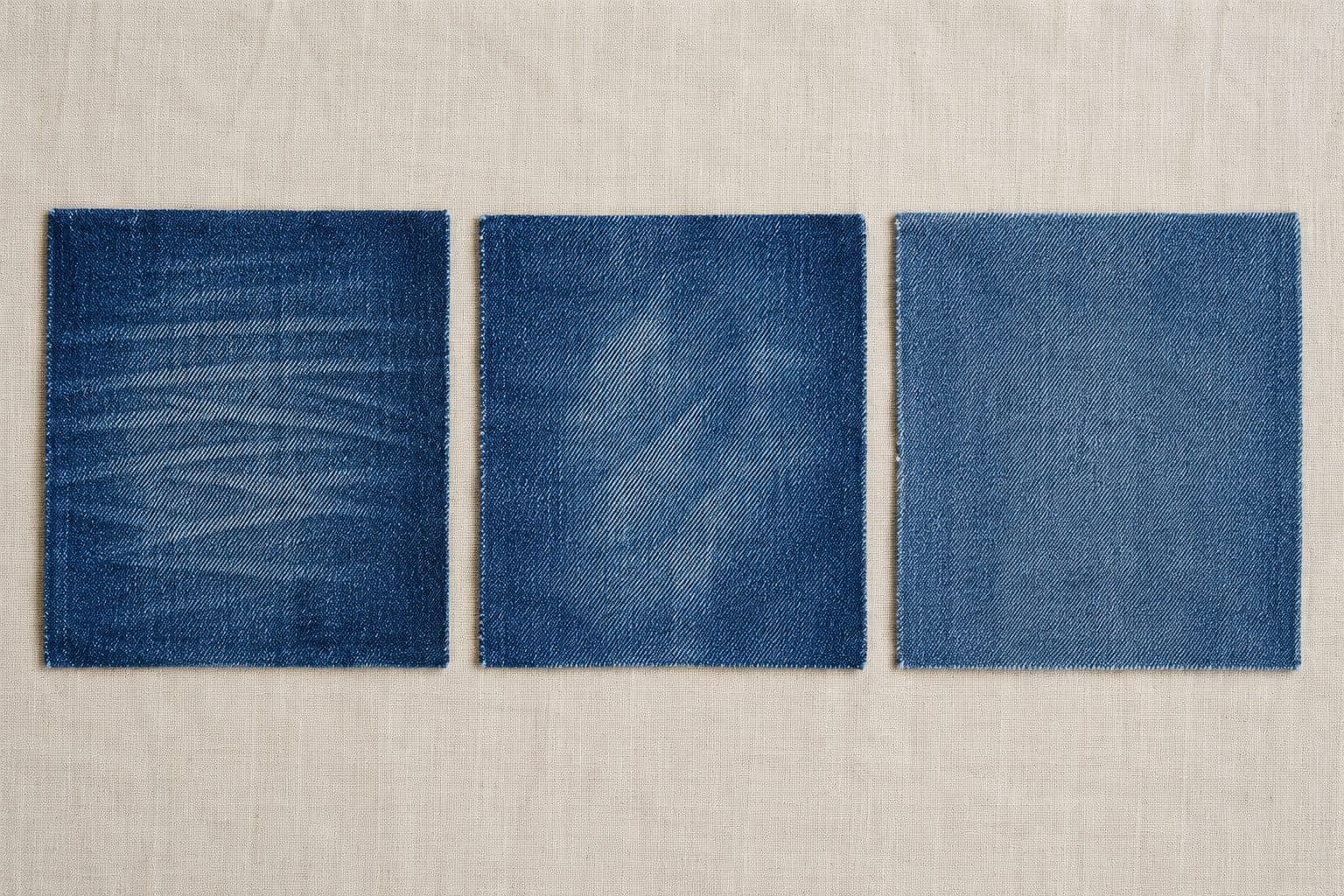
A pattern burned into the surface with light. No dust, no grit, no operator exposure.
Abrasive pads worked by hand over a form, with extraction at the bench.
Cellulase in the drum softens the surface evenly. The most common finish here.